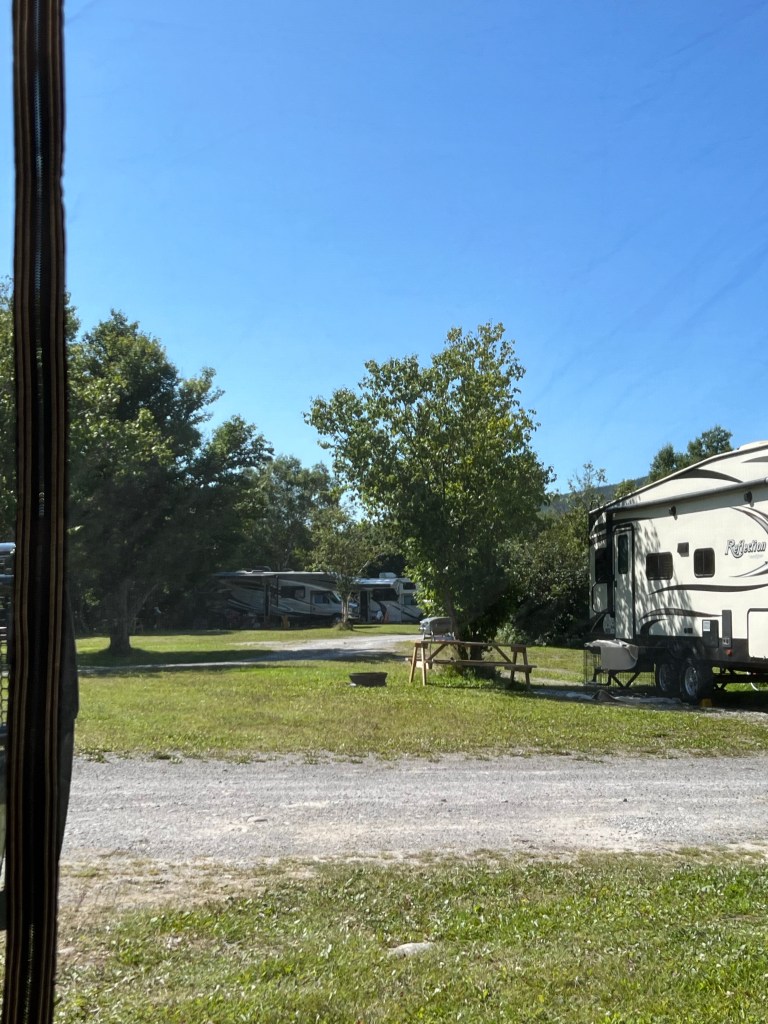
We are now at the Zenzville Campground in Kippens, just outside of Stephenville, NL. We’re back along the west coast and heading back towards Channel-Port aux Basques and the ferry back to Nova Scotia.
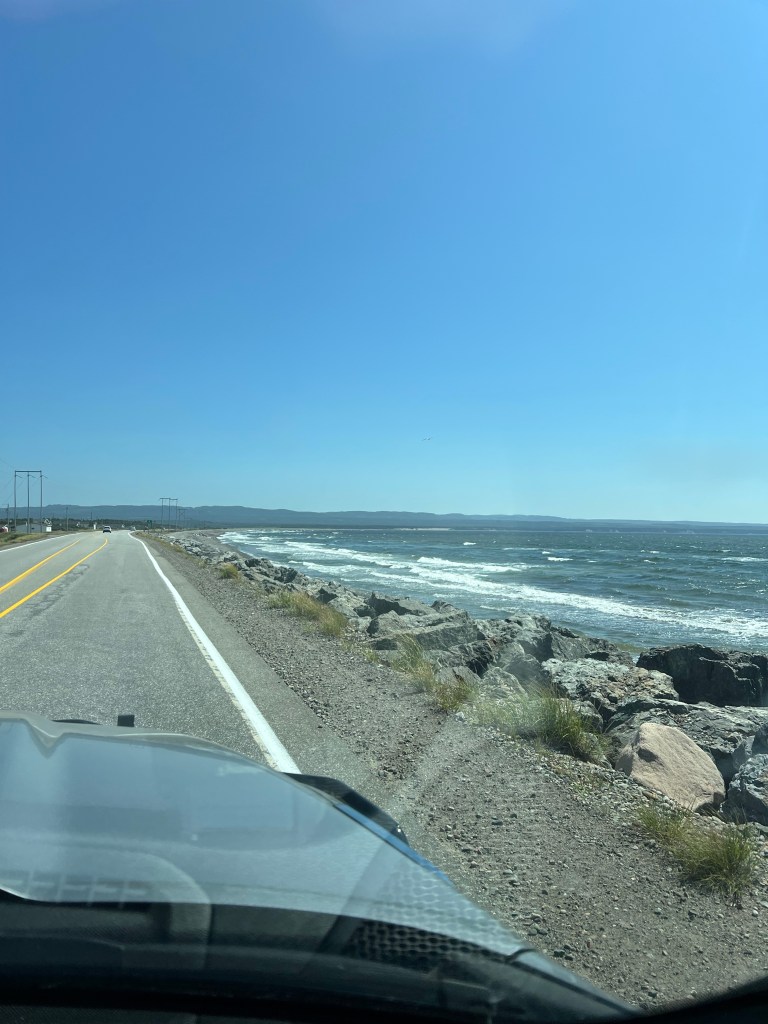
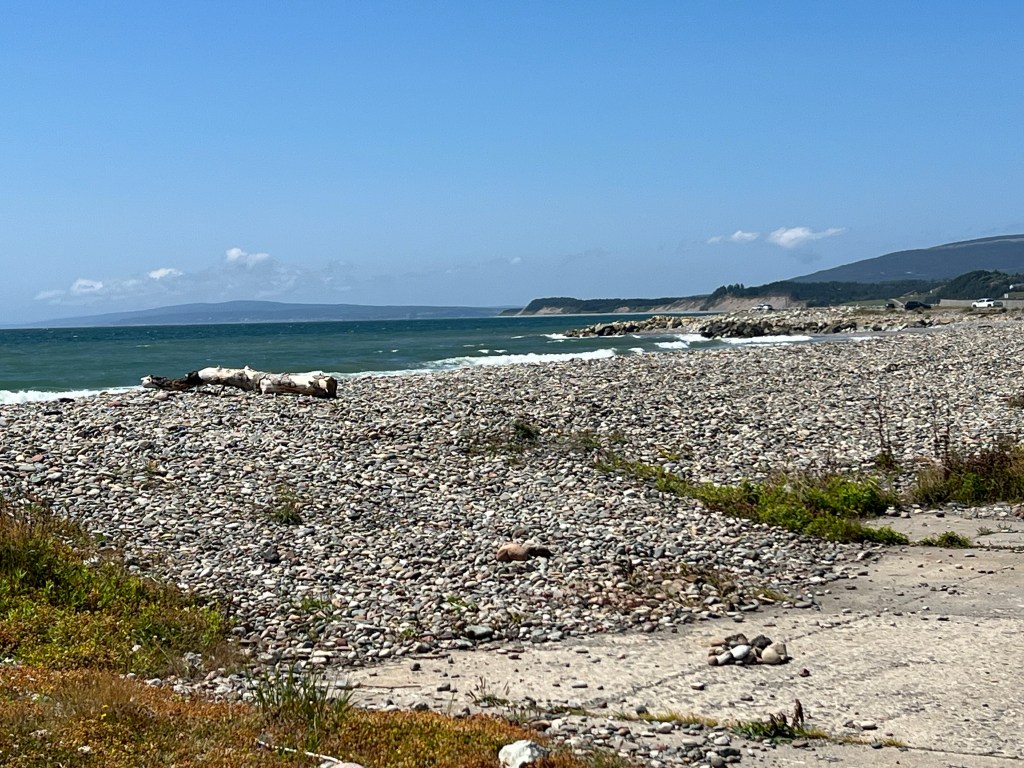
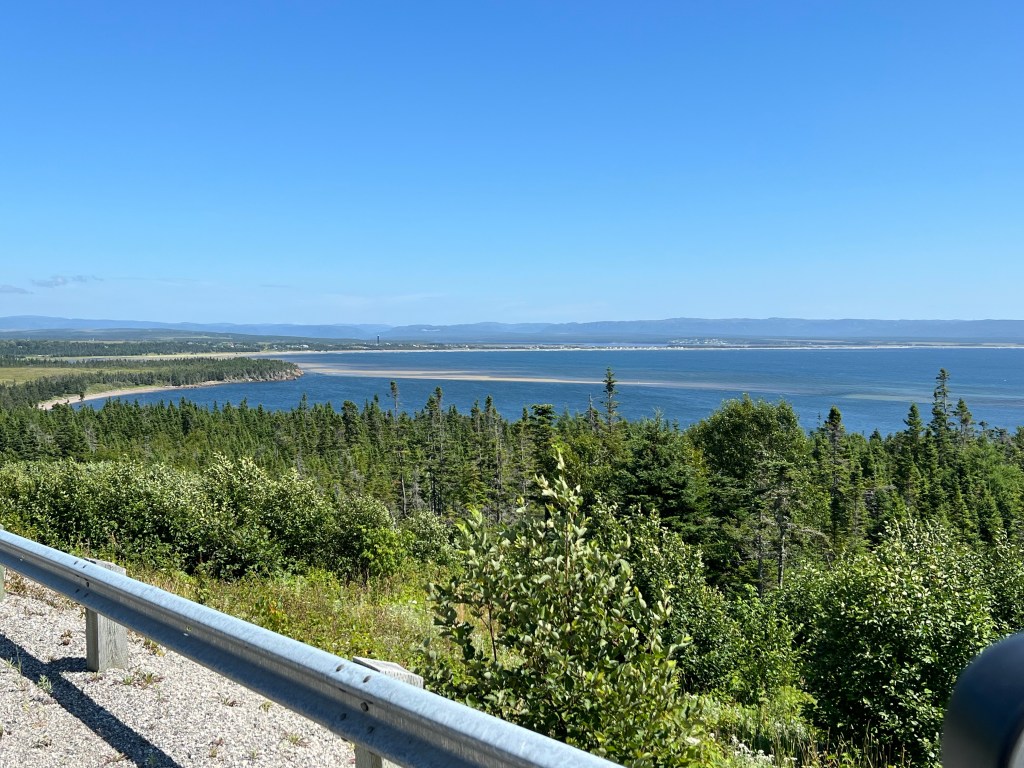
The coast right here is about the tamest we’ve seen on this island, with miles of beach.
This has its own beauty, and the dramatic cliffs are not far off.
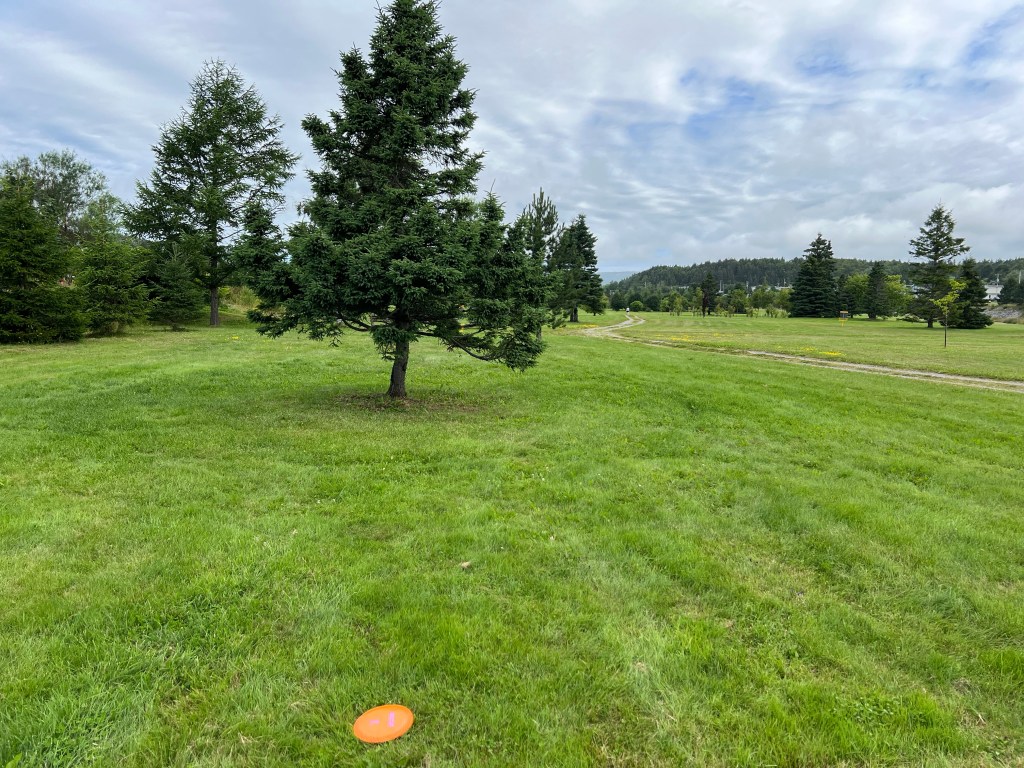
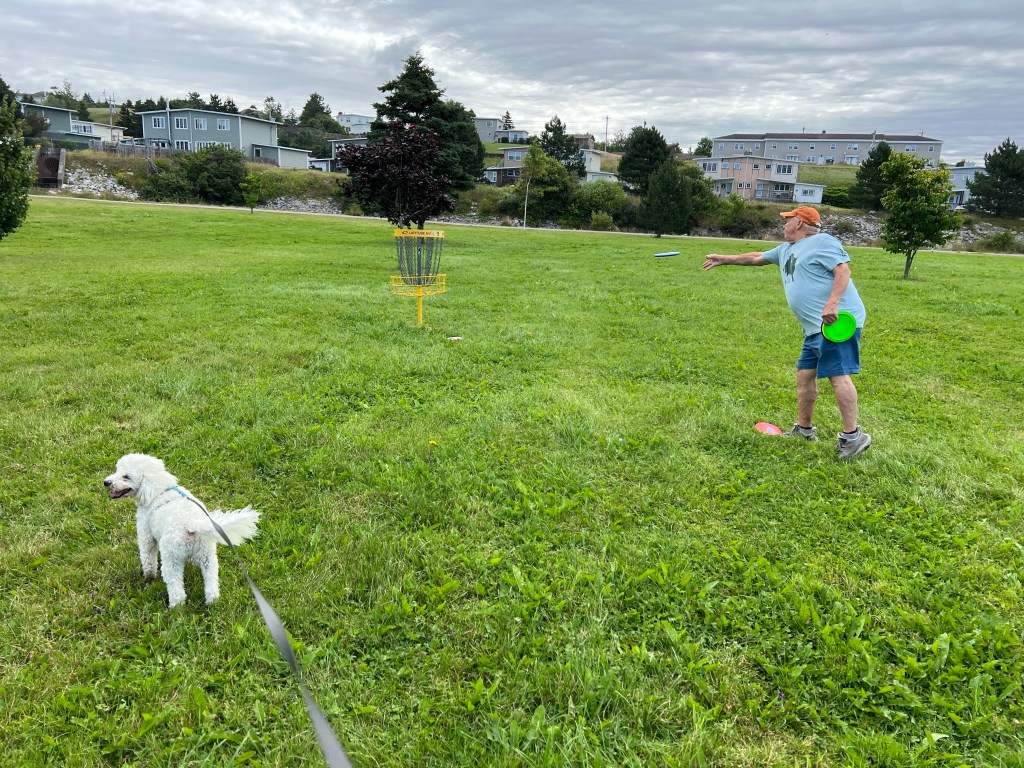
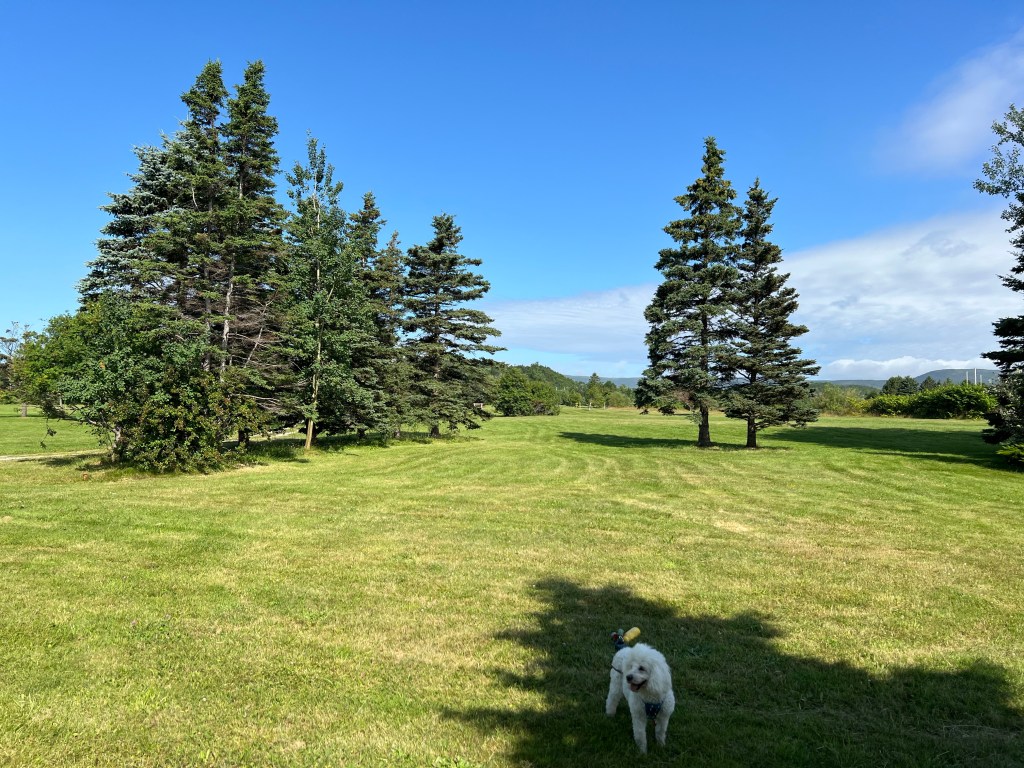
One reason I booked us here for a week is that Stephenville is “the disc golf capital of Newfoundland”. That’s not hard to do, as there are only 8 courses on the island; four of them are here. Today we tried Blanche Brook Disc Golf Course and were happy to find it was in a park with mowed lawns and lots of space among the trees.
It only had ten holes and Matey had to stay leashed,
but it was pretty and well cared for.
Matey was seeking shade (it was only about 70 degrees out) so 10 holes was enough. We’d walked about a mile.
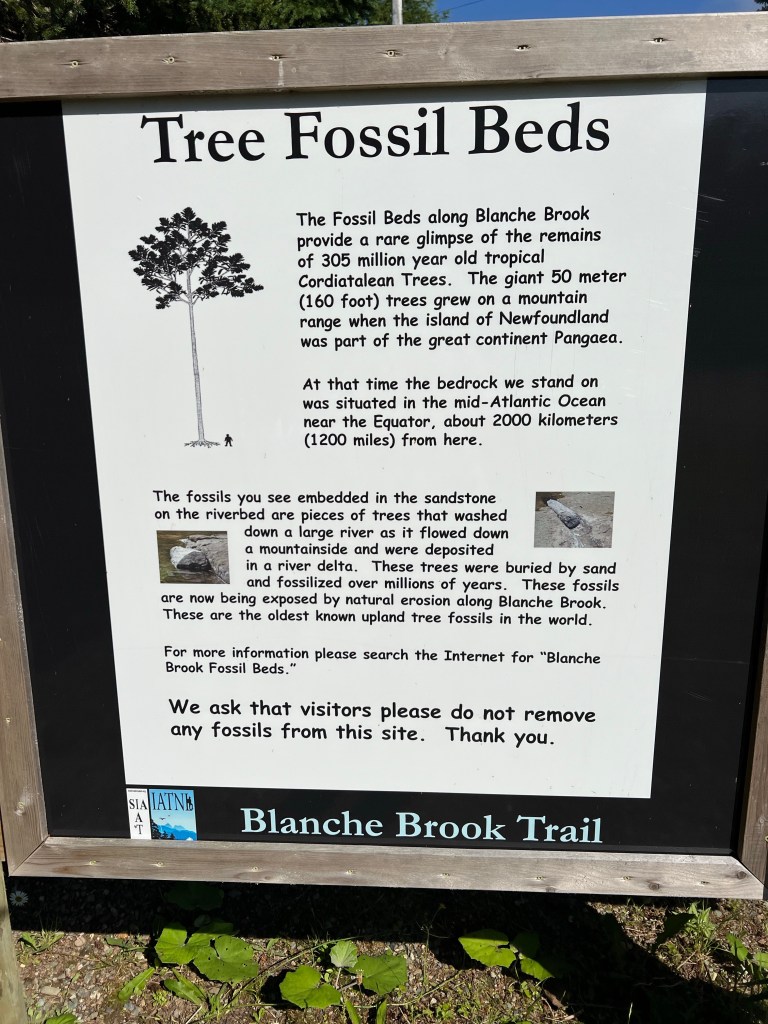
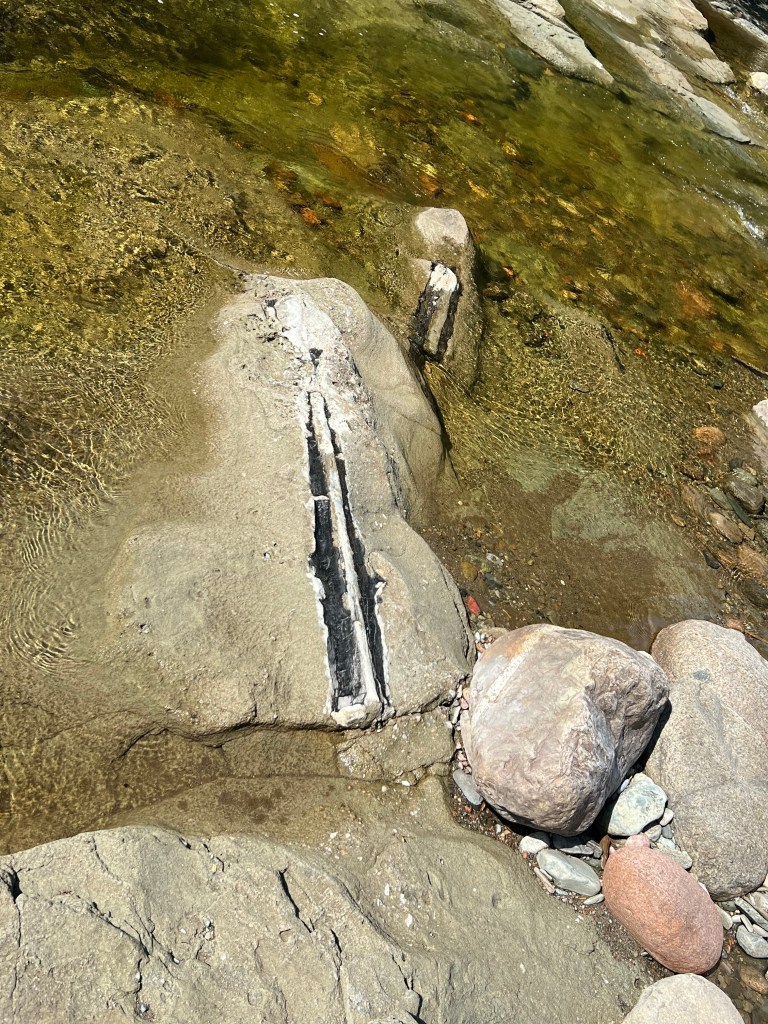
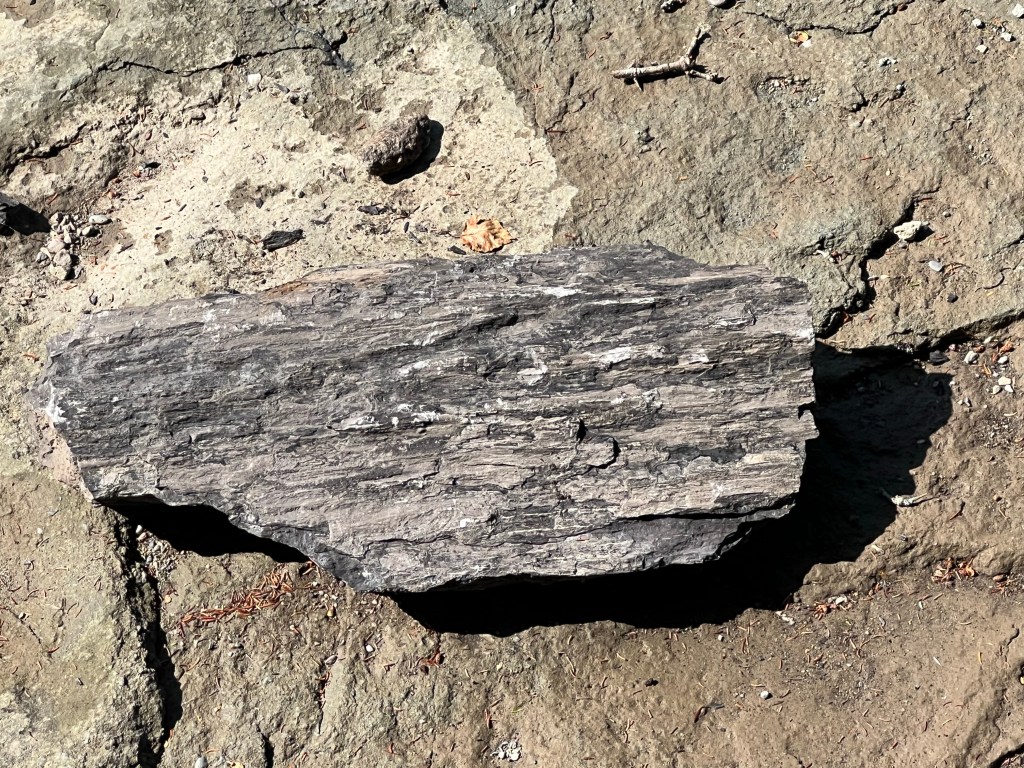
My travelers’ guide to Newfoundland mentioned an area of fossilized trees along the same Blanche Brook, not two miles away. Of course I wanted to visit. And of course these are the oldest known upland tree fossils in the world. This is Newfoundland after all.
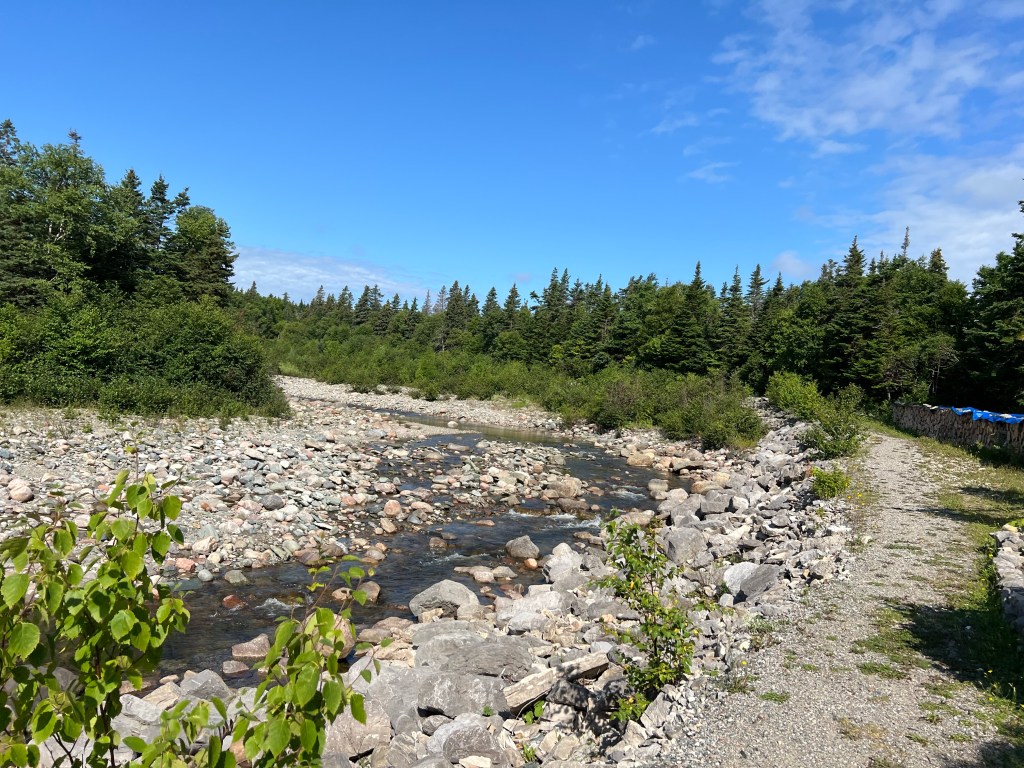
A short path took you to the brook, it was quite clear that we should walk upstream.
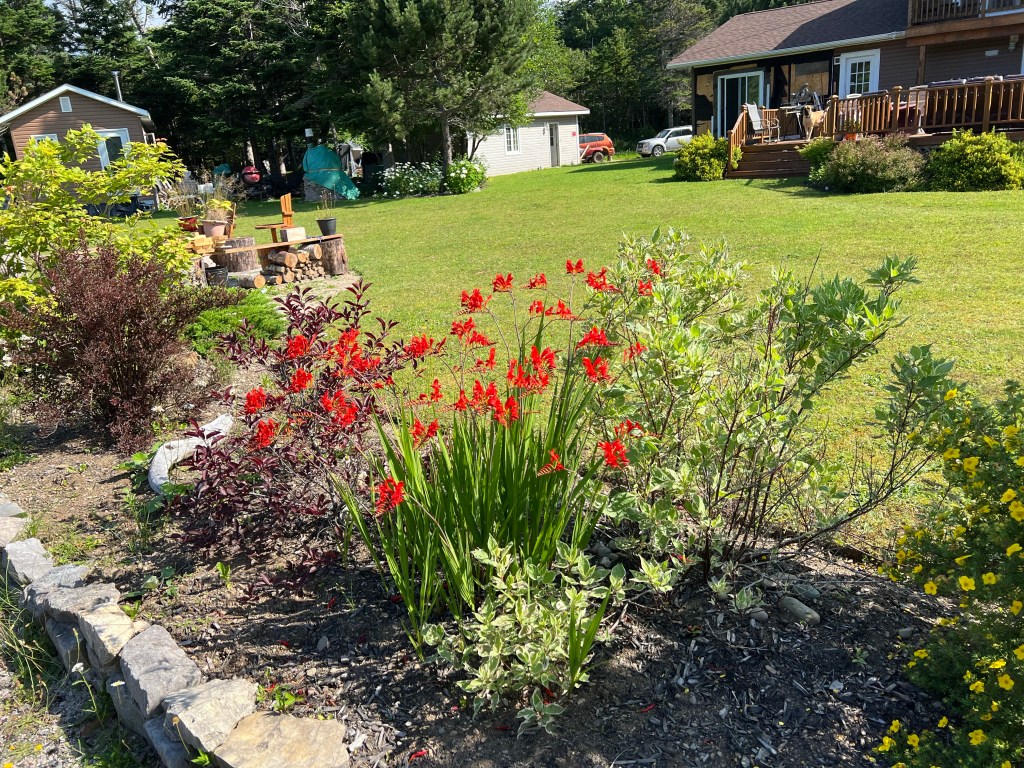
We passed behind a very nice house…
and continued along the edge of the brook.
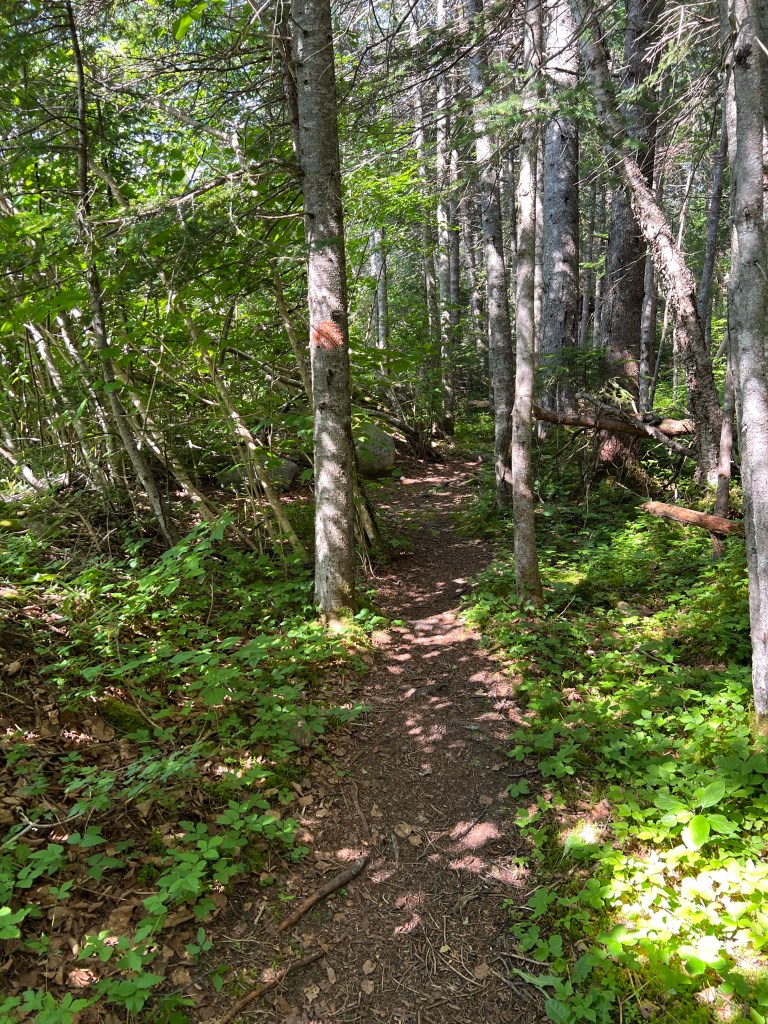
The path got quite small in places. Just as I was wondering if we’d missed the site I spotted this red blaze on a tree. Okay, carry on.
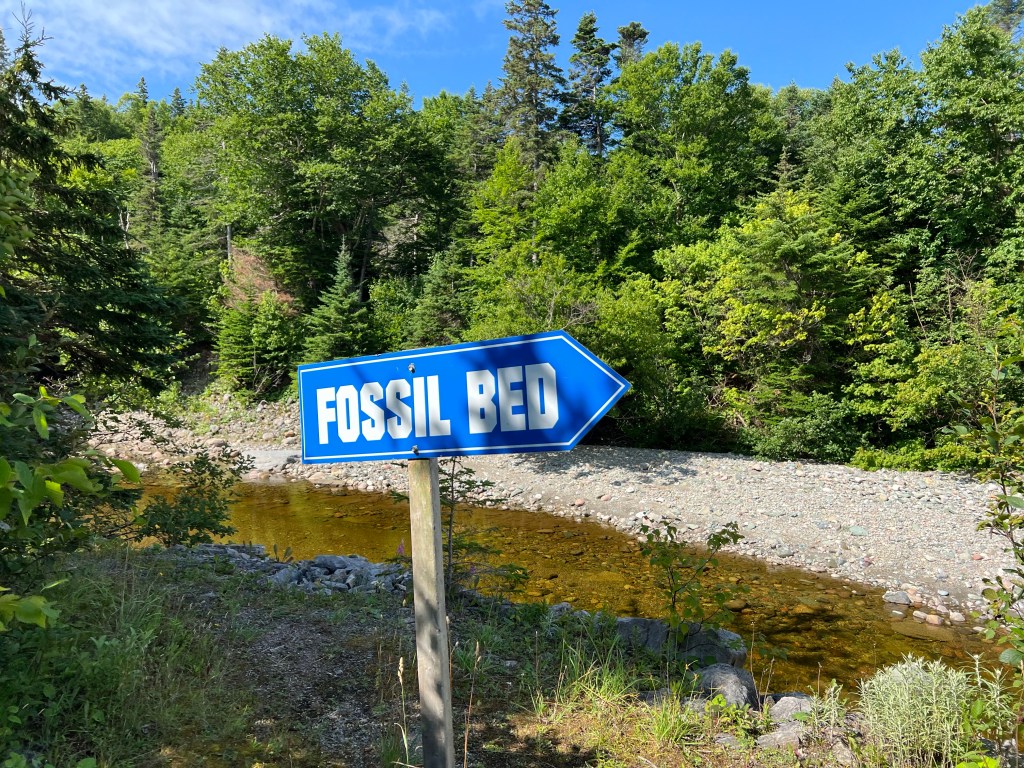
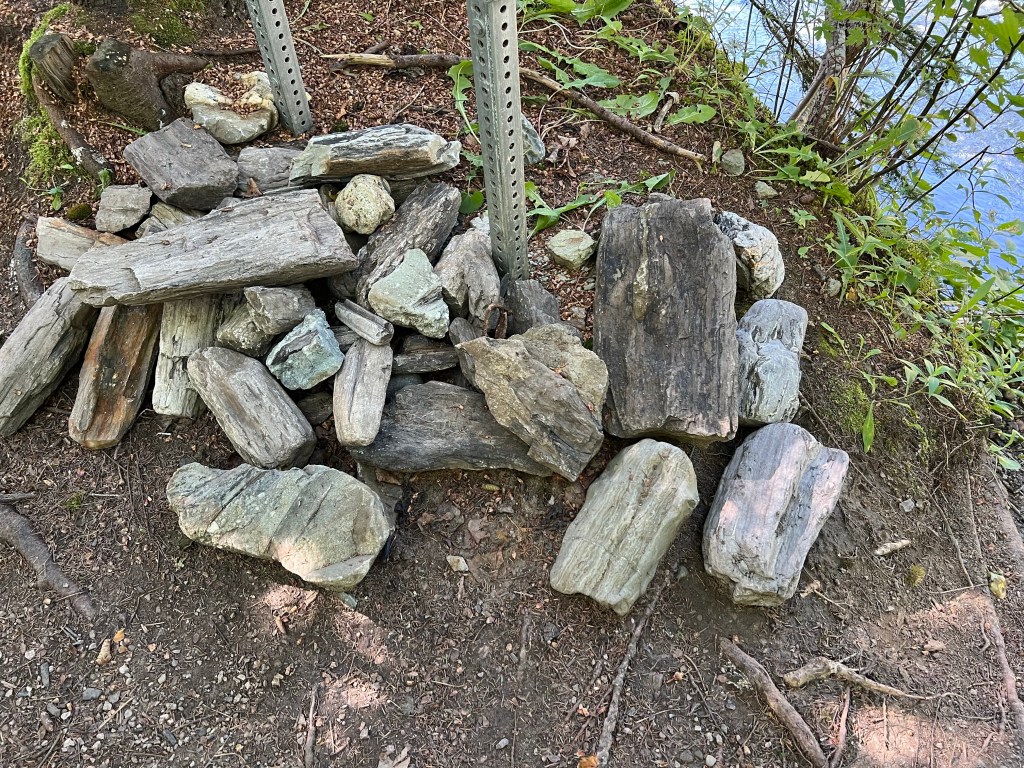
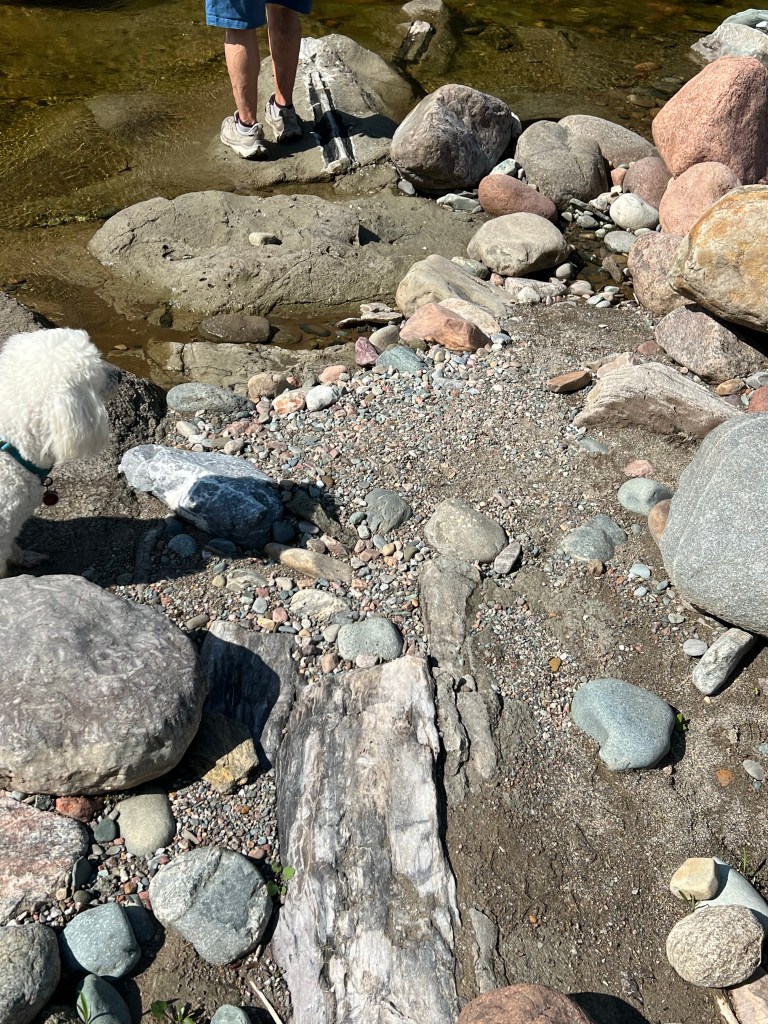
There was no chance of missing the spot, there was a sign surrounded by pieces of fossil logs.
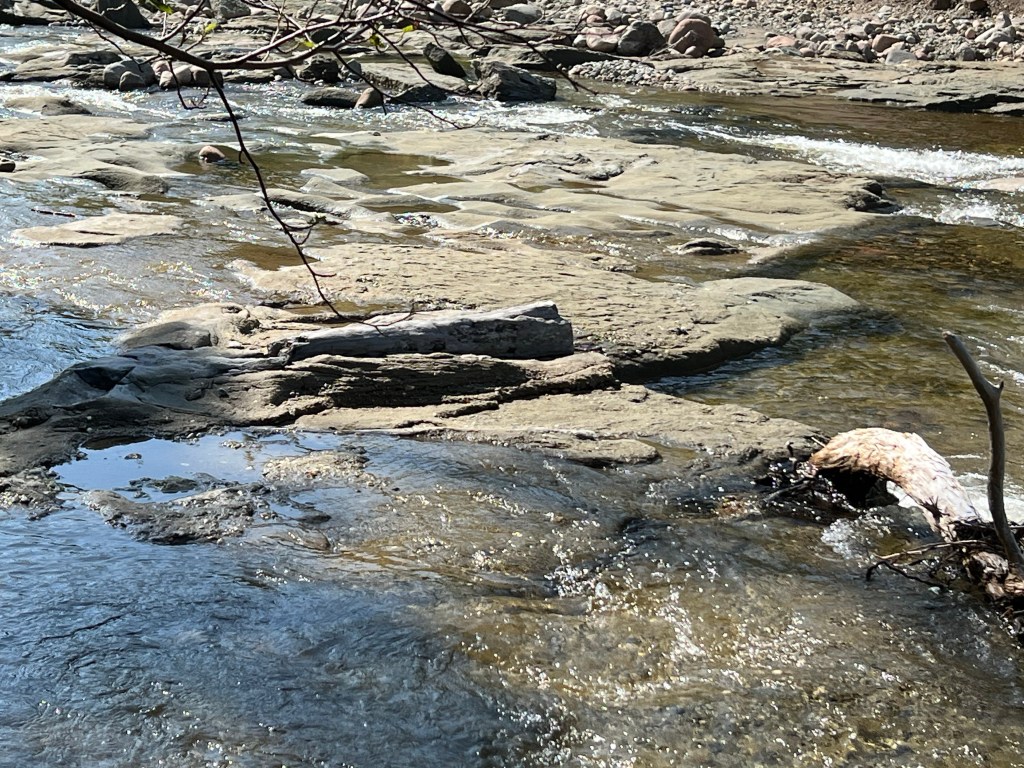
There were plenty more in the creek bed.
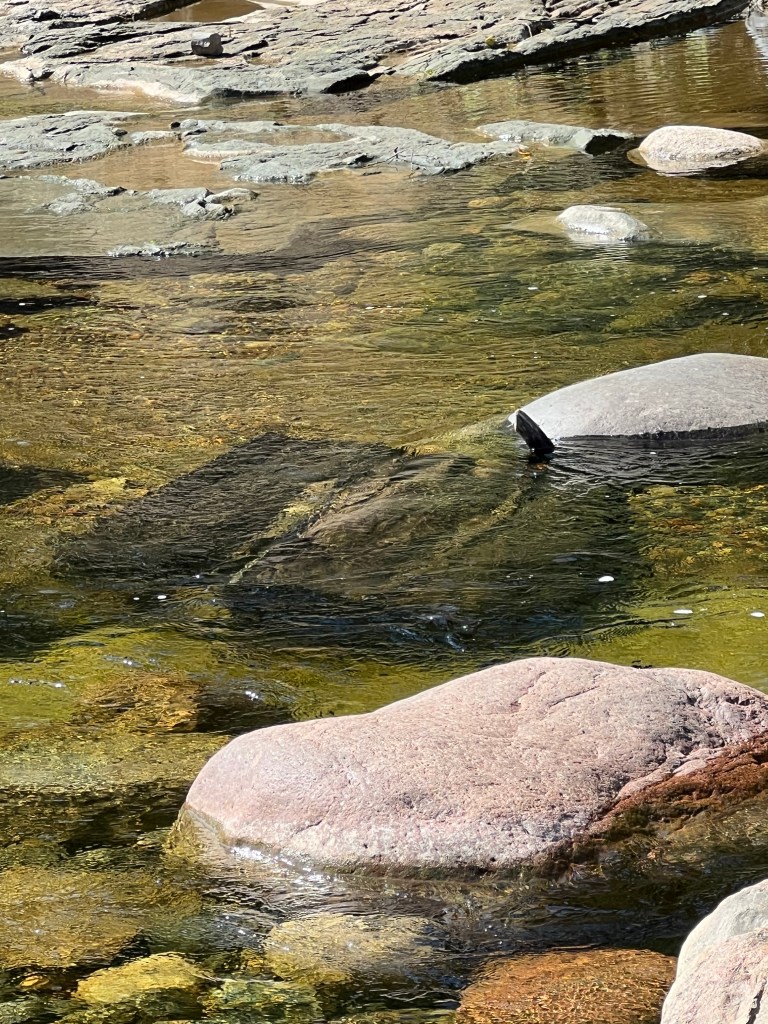
Some were underwater.
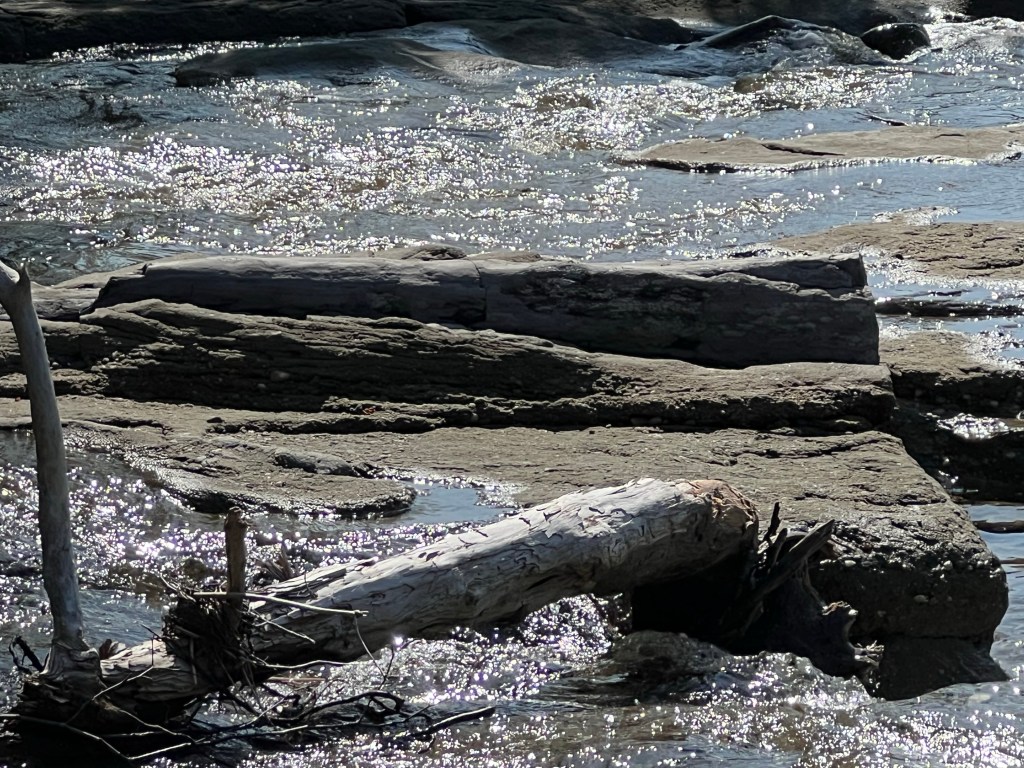
There’s a big one behind a piece of modern driftwood.
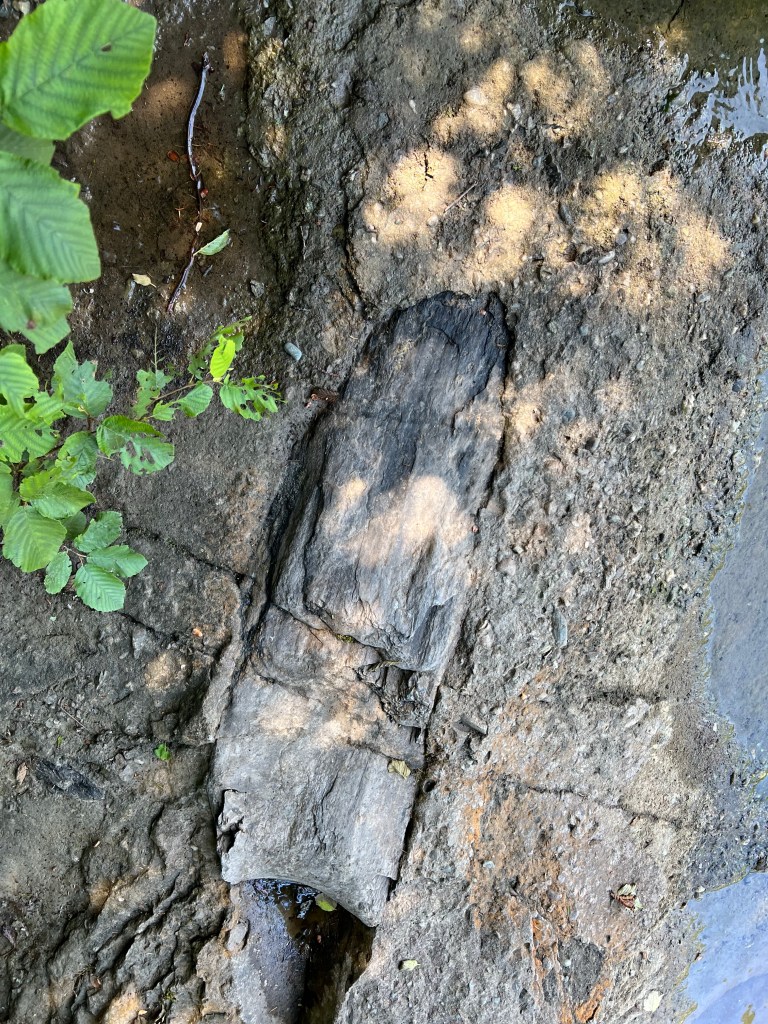
This was my favorite, see the piece that broke from it above and to the right?
Bud noticed what could well be a piece of its lower trunk, too.
What a nice find…
and it was all just sitting there with a sign saying please don’t take these.
This afternoon we took a drive that ended on another dead end dirt road. Coming home there was an accident and we had to turn back to make a detour. The shortest detour was 12 miles around. It made me think of route 360, down to Harbour Breton. There is no detour available there, you would just have to wait.
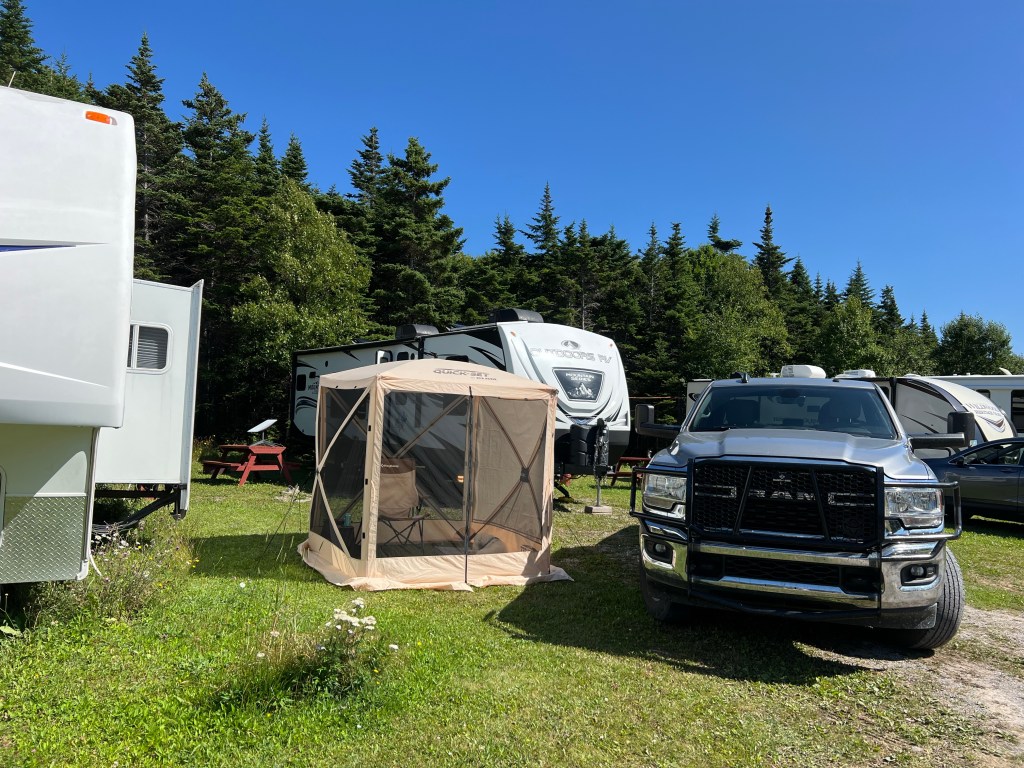
But we did make it around and back to camp and now Matey and I are enjoying the screen house, which just fits on our site.
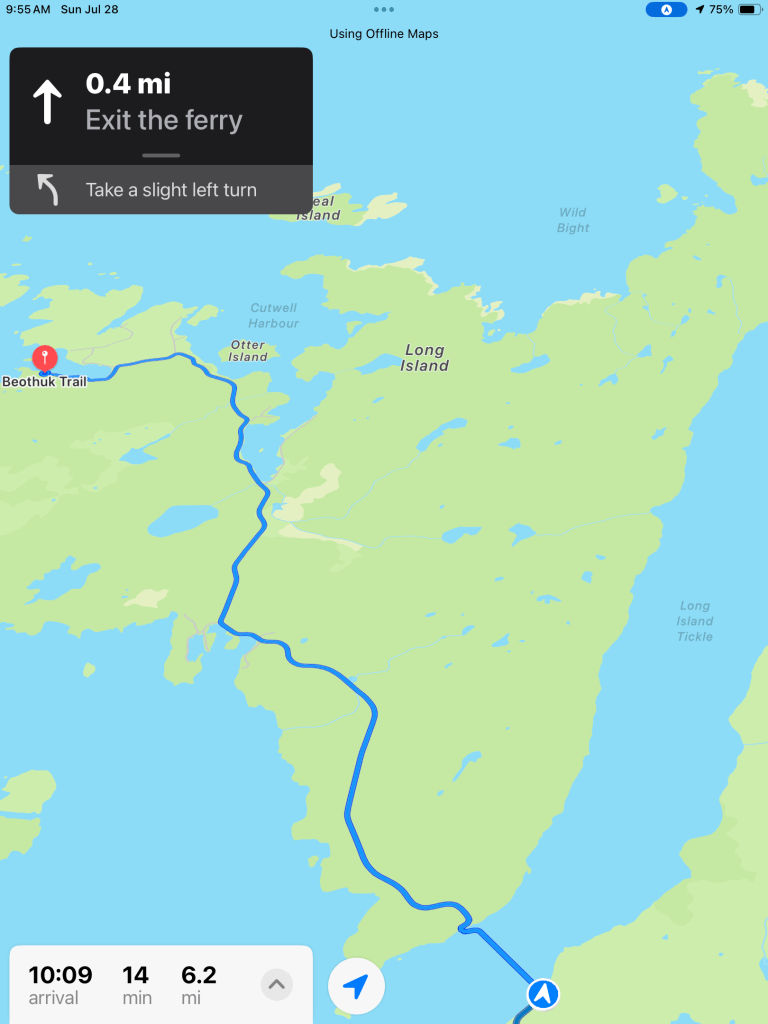
The problem is Newfoundland has 6,000 miles of coastline, and every mile is beautiful. Yesterday we decided to try another ferry, this one to little Long Island and the Beothuk hiking trail.
This ferry took vehicles, but only 16. After our last experience we didn’t want to be left out, so we arrived at about 9:10 AM for the ten o’clock ferry. Here we are, first in line.
There were a bunch of jellyfish to amuse us.
About 20 minutes later the ferry…
started its 5 minute trip to our side. In case you weren’t sure what you wanted to do on Long Island this sign listed the attractions.
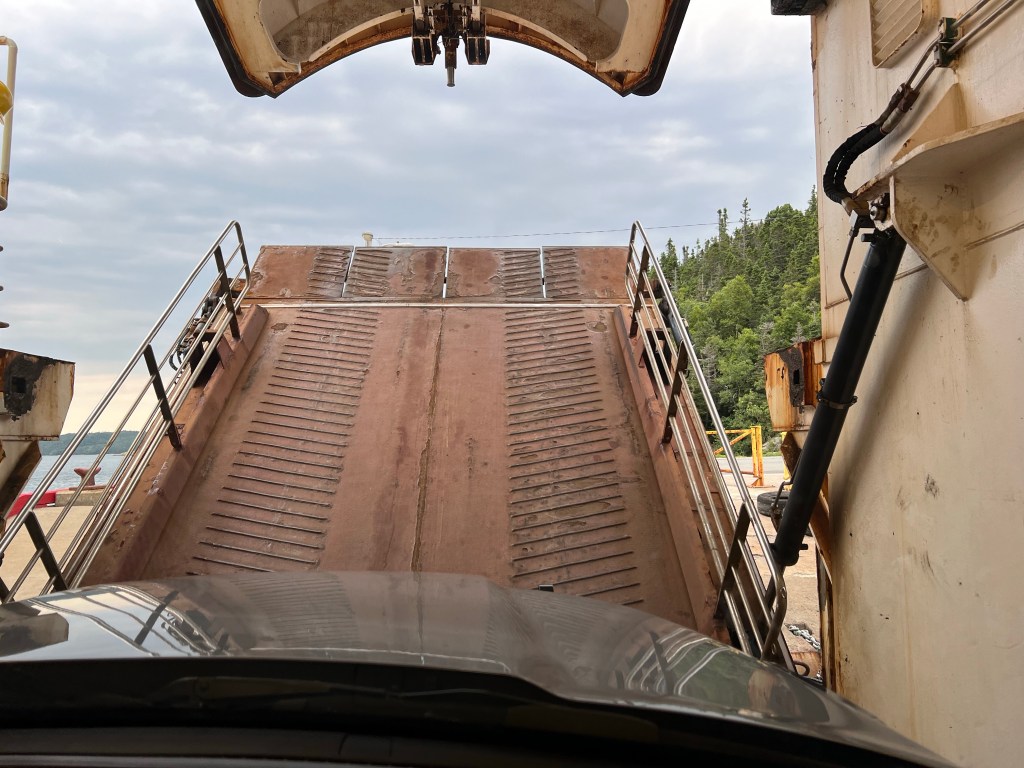
We were loaded right up front by the bow. It’s the first time we’ve stayed in the truck in an enclosed ferry during a crossing. It was noisy.
You can see the press of vehicles in our rear view mirror, all three of us.
We left the ferry…
and soon came to the hiking trail…
it was less than six miles across the island.
The locals made you feel welcome..
and the trail itself was inviting.
And then there were the views.
I took these at the first lookout..
where a couple who grew up in this little place were flying a drone trying to track whales. They lost the whales and we never saw them. They told us her dad had cleared the trail to this lookout, Amos’s Lookout. He was Amos.
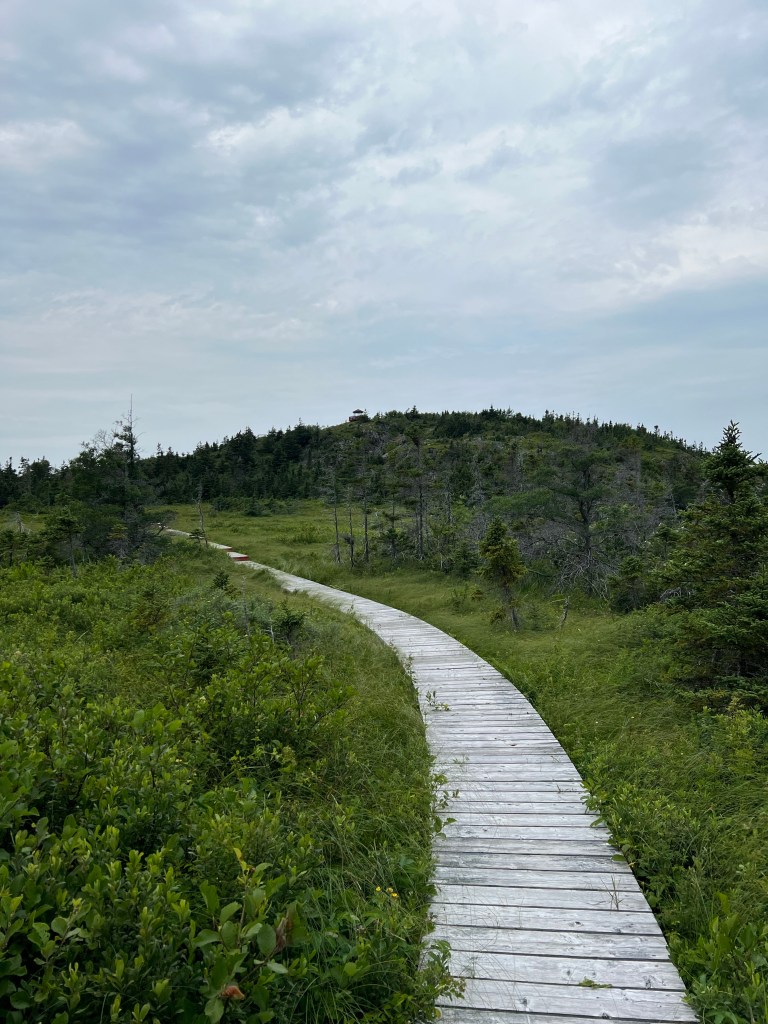
As they were trying to get their drone back, before it ran out of power or the wind got it, we walked on. Up the hill we came to this bog.
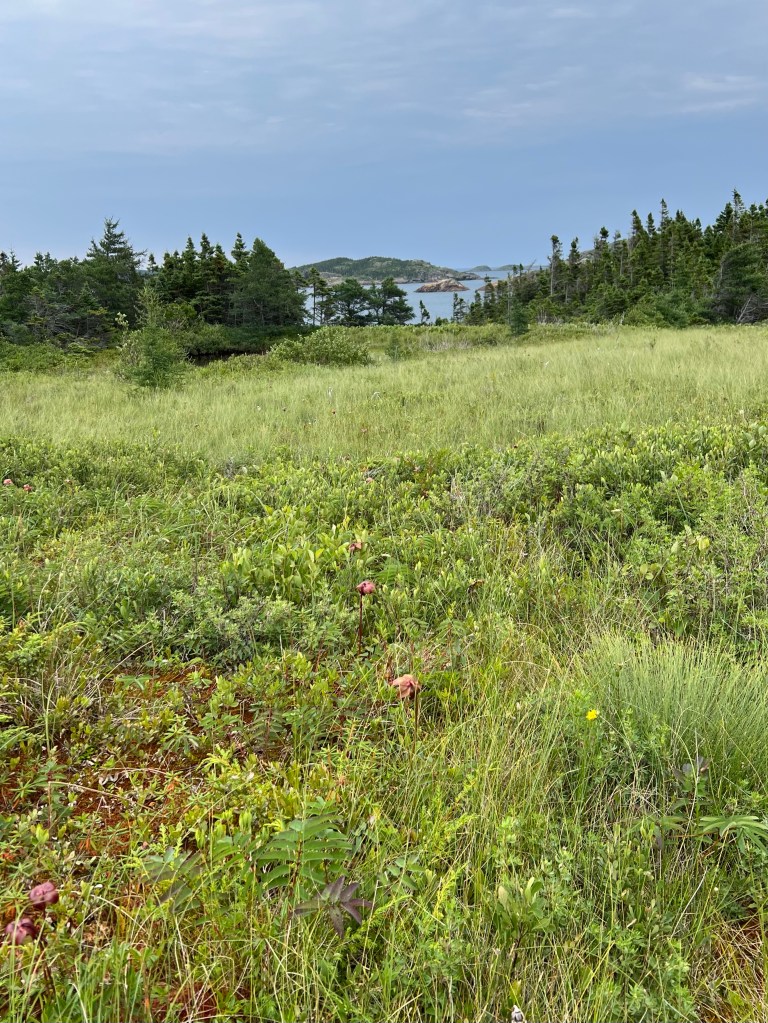
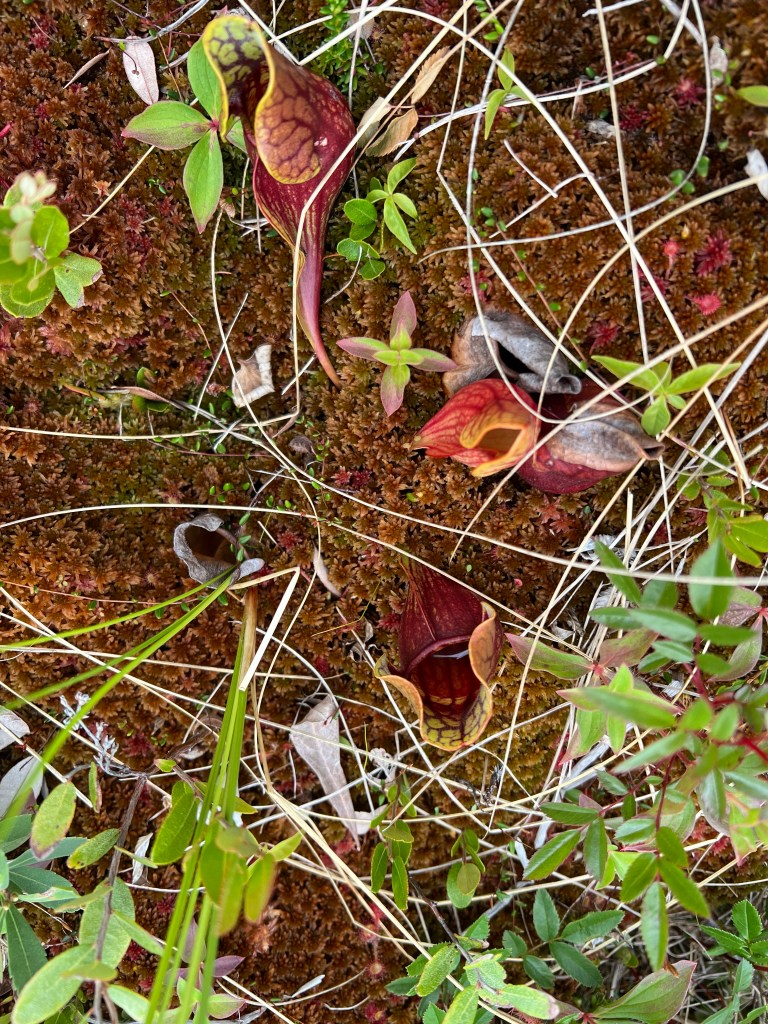
You could look across the bog to the cliff and the ocean and islands beyond. Those are pitcher plants in the foreground.
I think they’re beautiful even without their flowers.
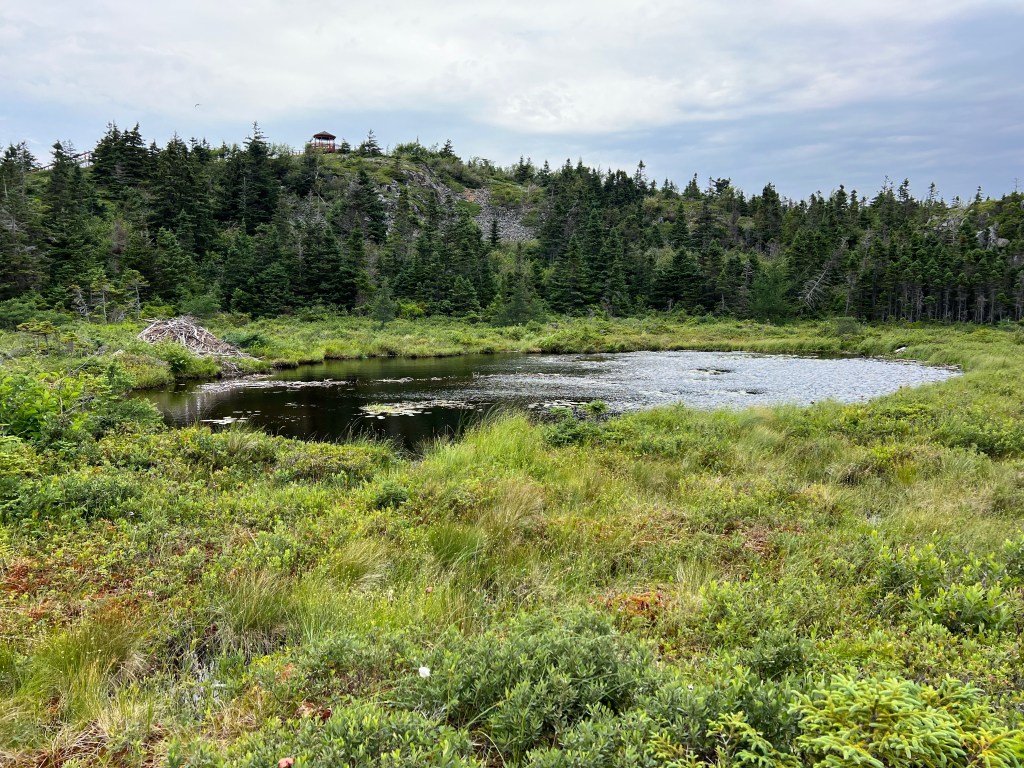
We went past this pond with a beaver lodge and bypassed the gazebo on the knob…
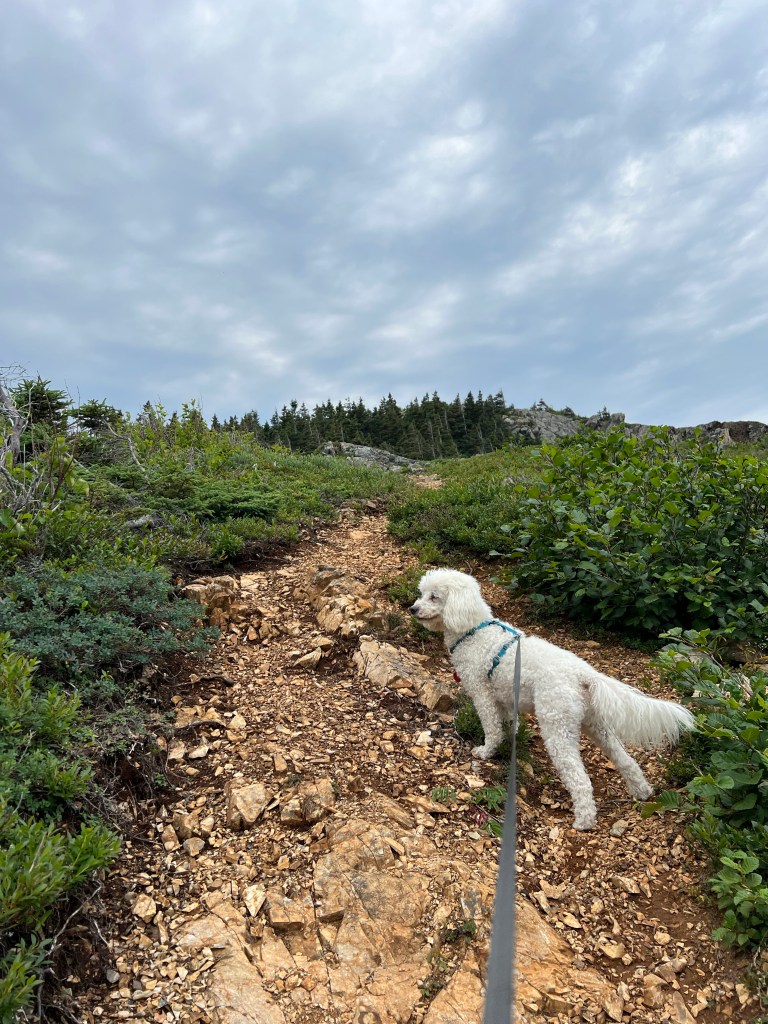
to climb up a steep slope…
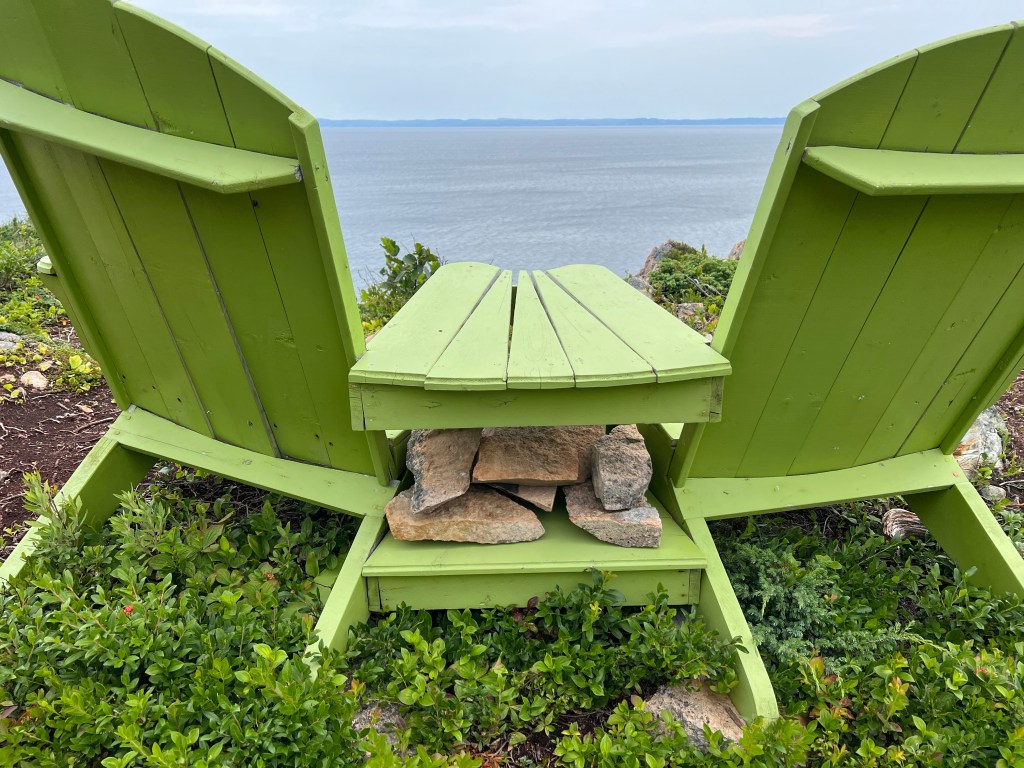
to an outlook with these chairs. The rocks are to keep them in place on windy days. Newfoundland gets lots of wind.
We looked for whales and just enjoyed the views.
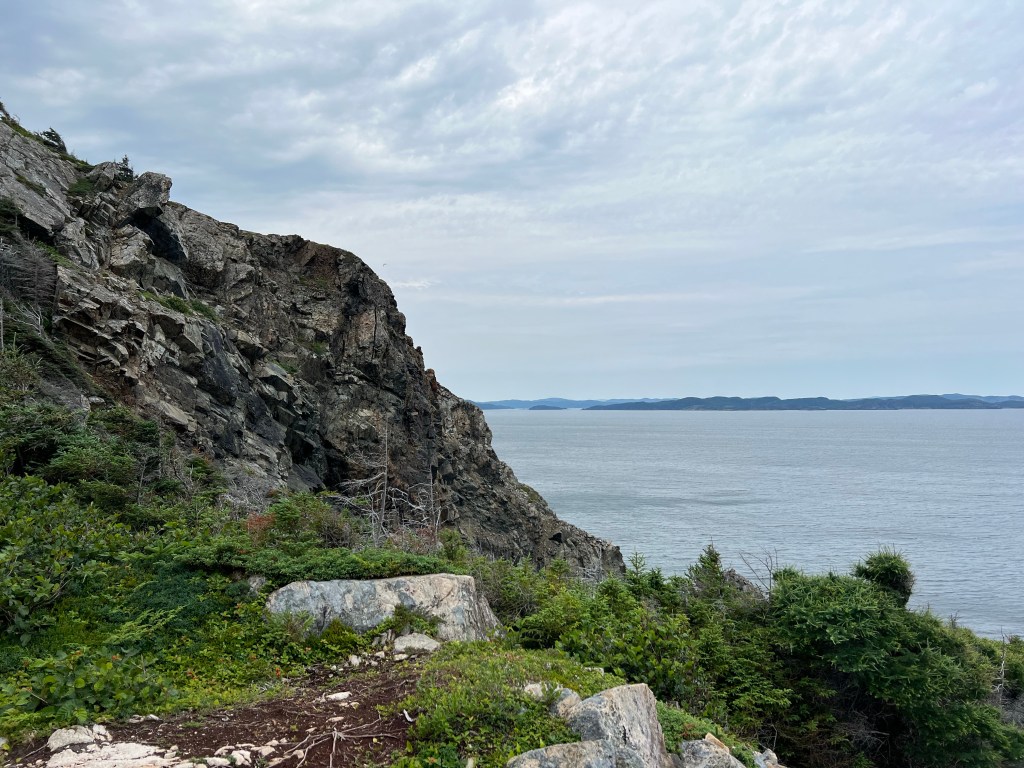
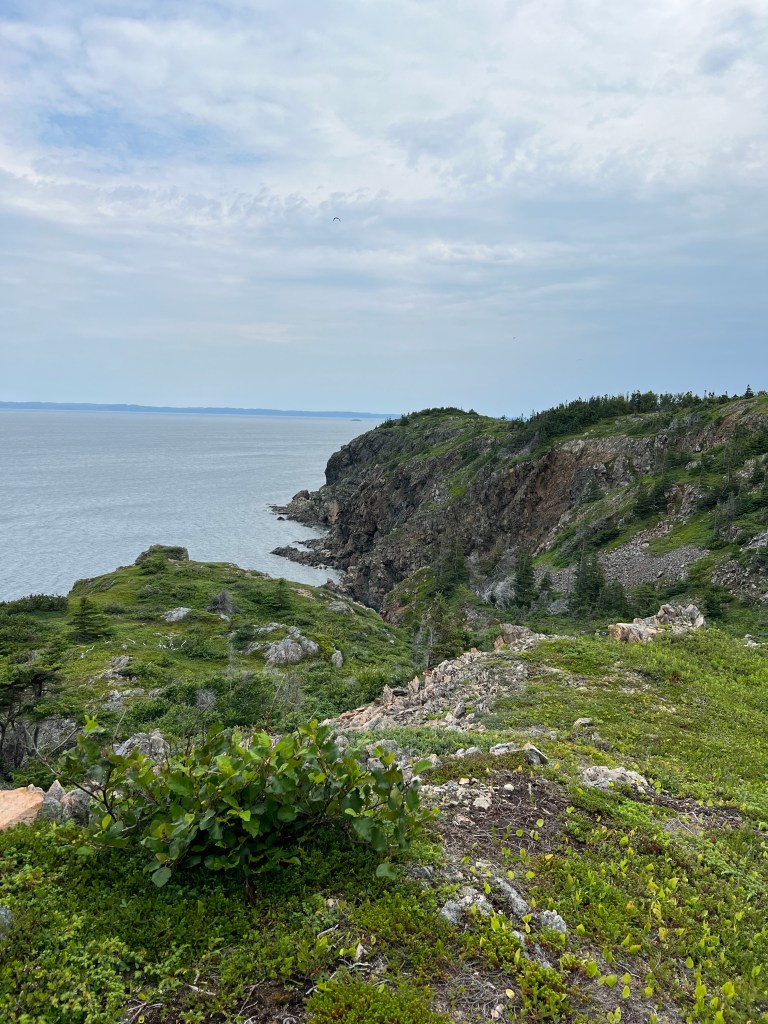
Very rugged and very lovely.
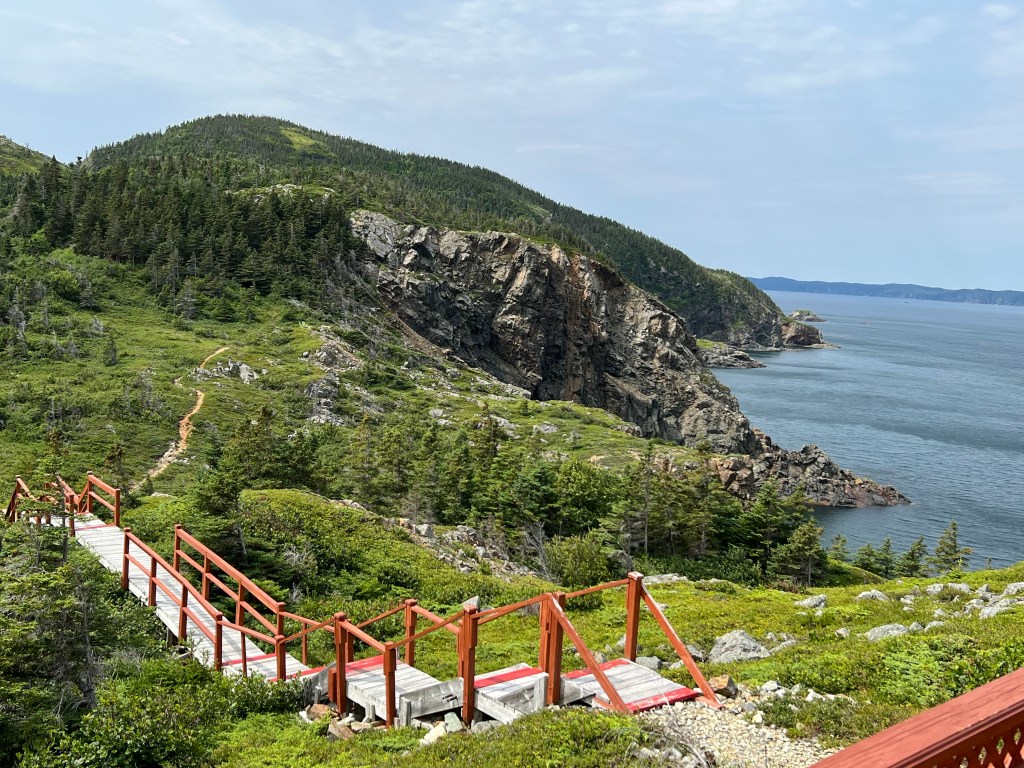
We came back from the chairs and climbed these steps to the gazebo on the knob hill.
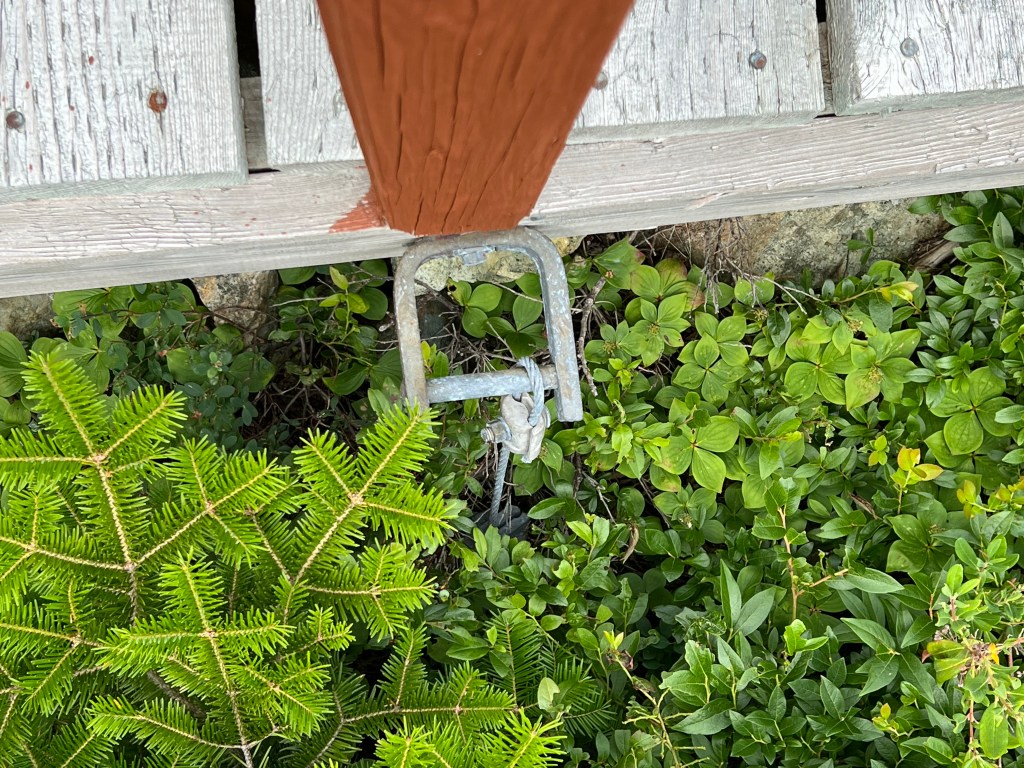
The steps and walkways were all cabled down…
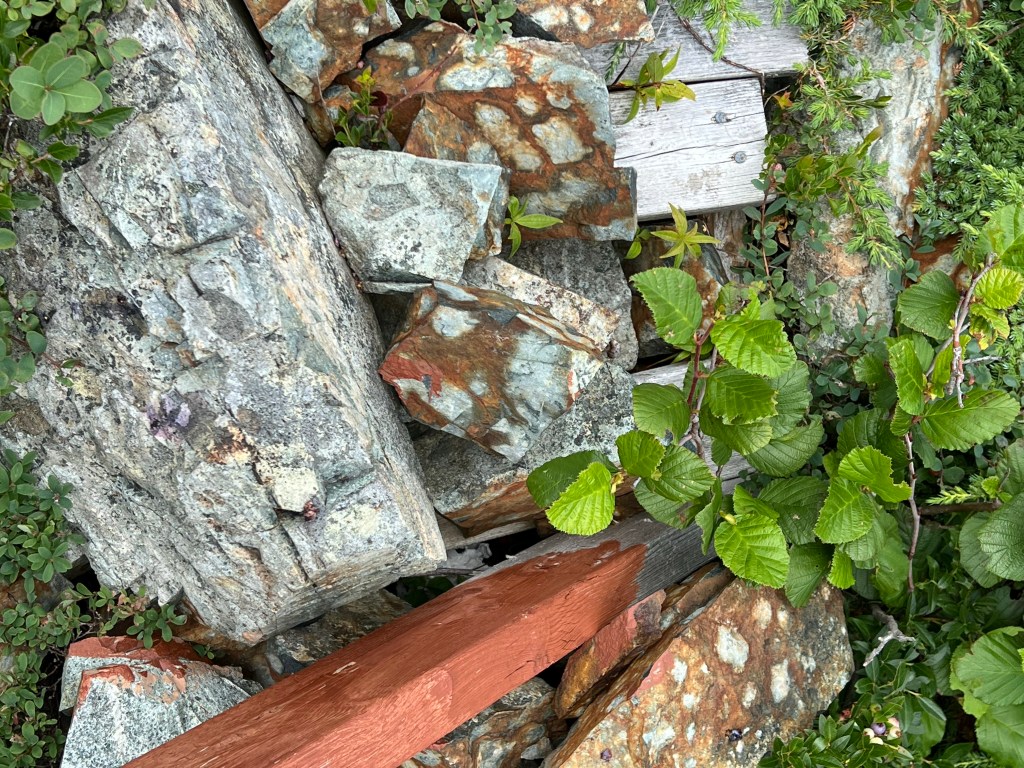
or weighted with rocks against the wind.
I took picture after picture of the gorgeous landscape in every direction. Finally I just took this video as I moved around to catch the 360 degree beauty.
We walked back the trail and left the little town of Beaumont…
and drove back across Long Island to the ferry.
We were first in line again, but this time the ferry had more customers. I took this video of a straight truck being loaded. He was the last one to come on. These ferry workers get the vehicles in without any wasted space. They even folded in the mirrors on the vehicles on either side of the truck.
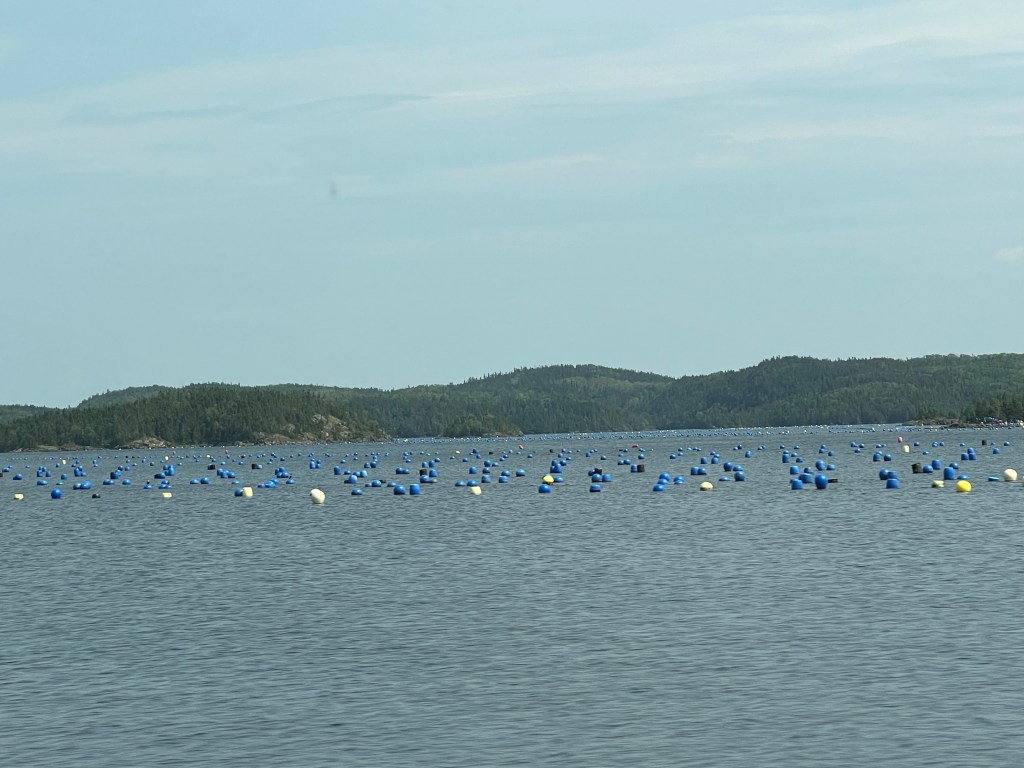
We then drove across Pilley’s Island to Triton Island and finally across to tiny Cobbler Island, all of seventeen miles. Along the way we saw these bouys, set out for some kind of aquaculture,
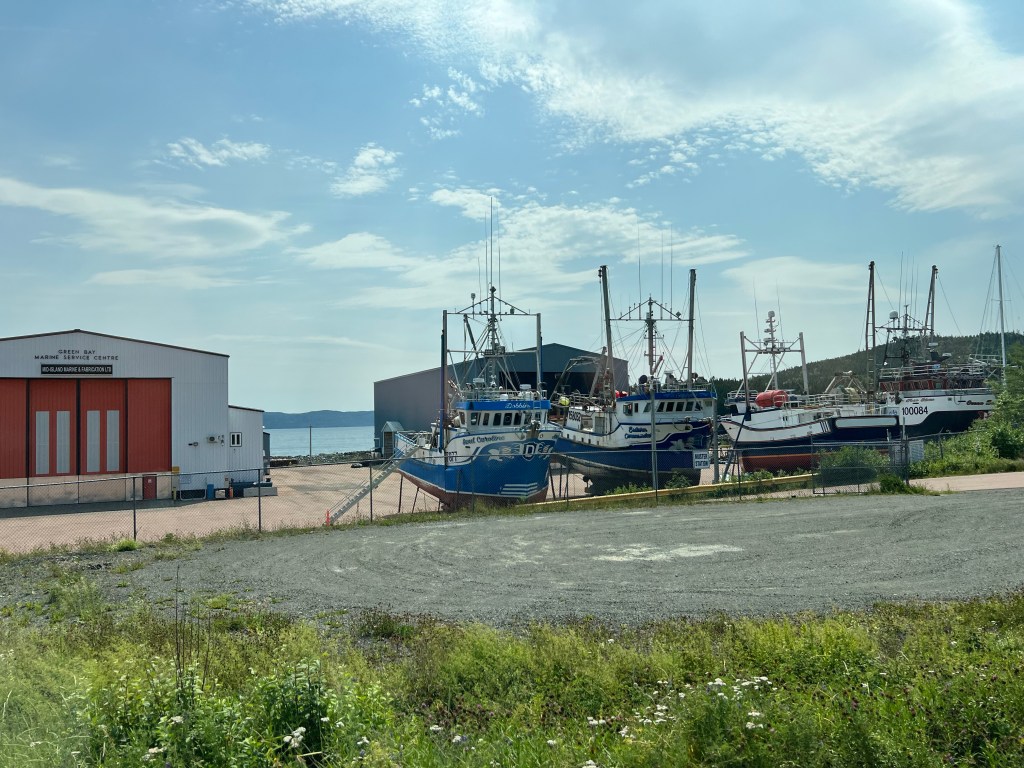
and this good sized shipyard.
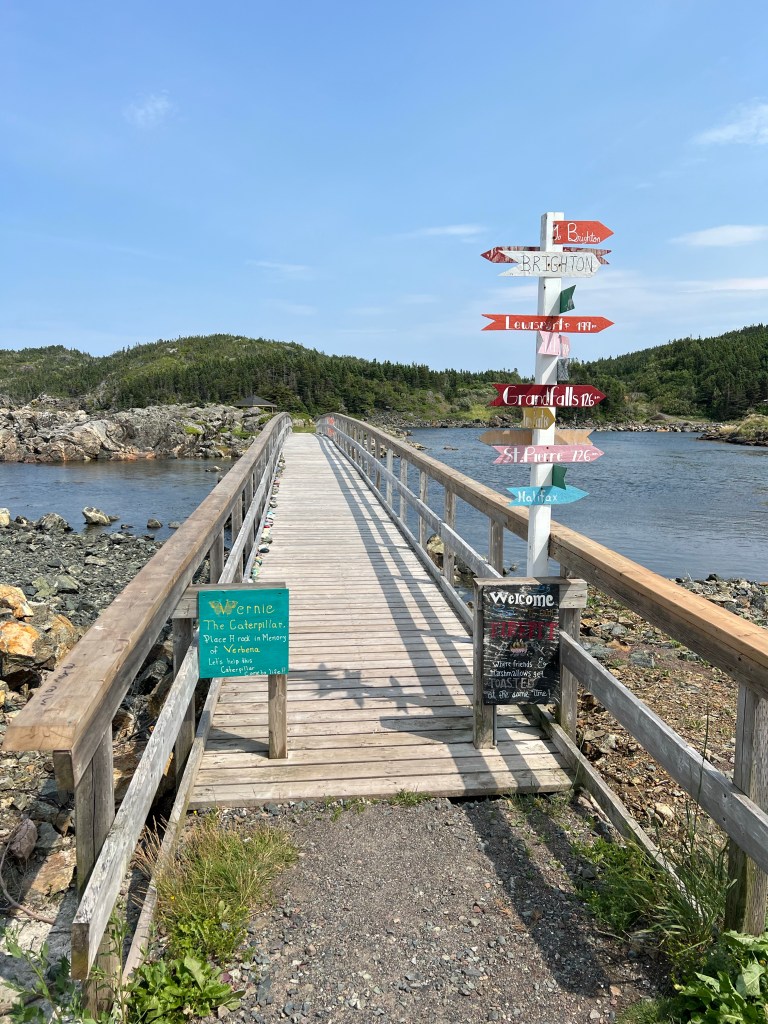
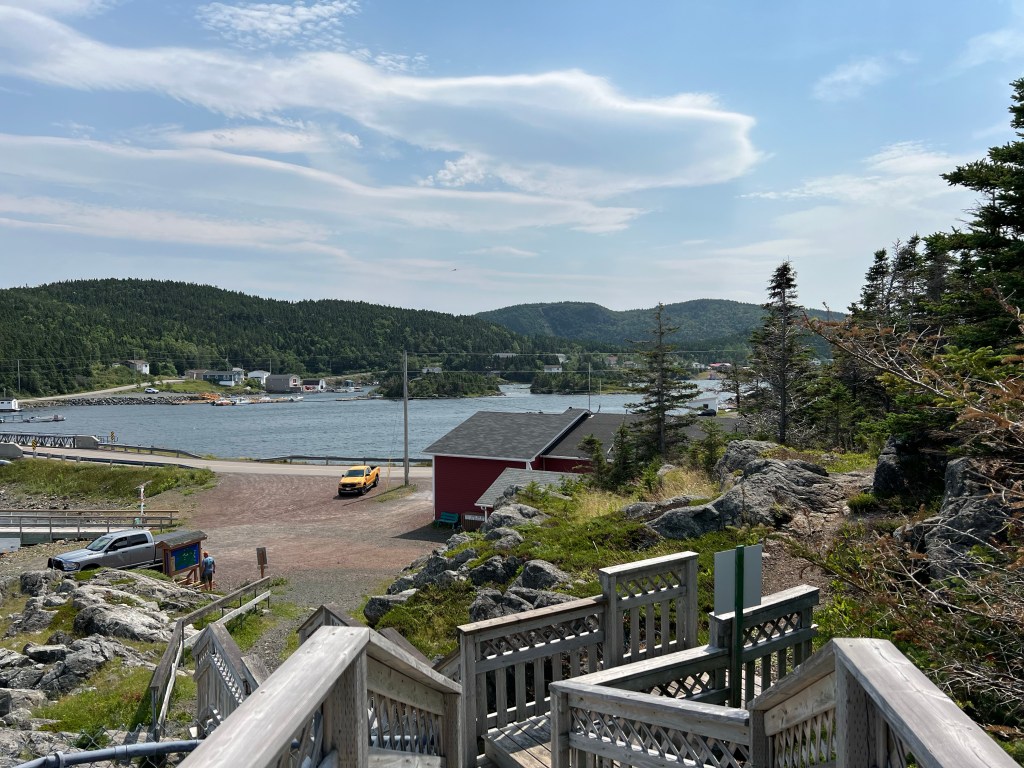
Cobbler Island had this bridge to a bit of island with a gazebo on it.
We walked up the nearby steps…
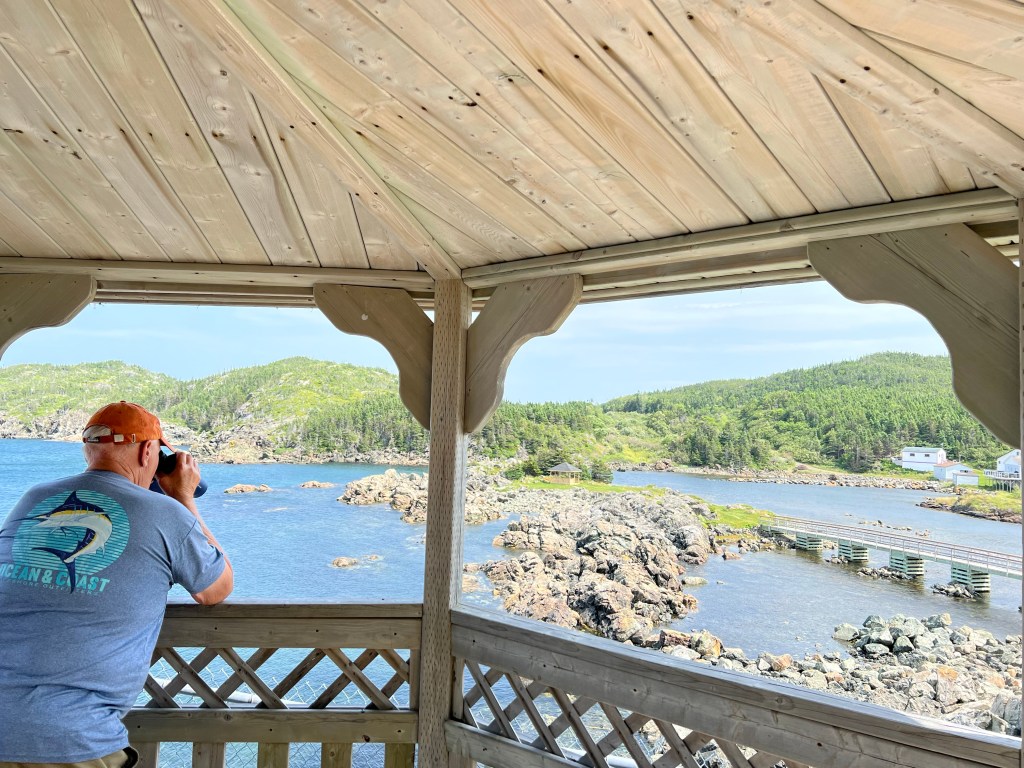
to this very nice gazebo. It looked down on the bridge and little island…
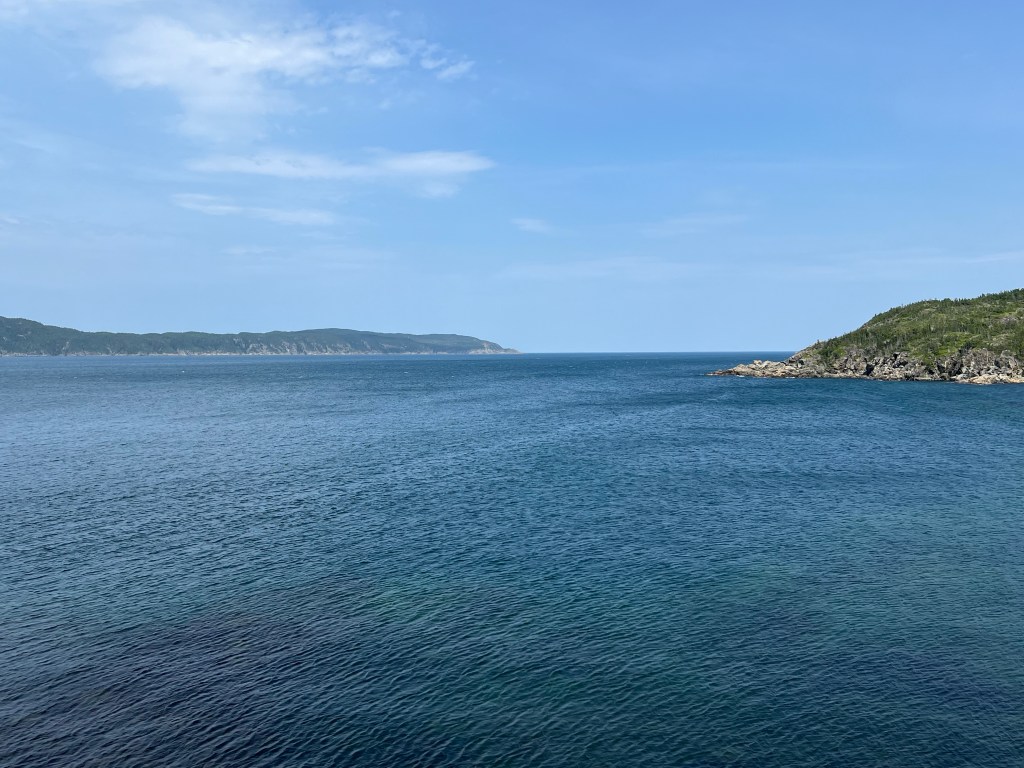
and gave a great view out to sea…
and along their piece of beautiful coastline.
As you can see, everywhere we went it was picturesque, pretty or downright stunning. It was hard to find the pictures to tell the story without overwhelming you.
Thursday morning we said a reluctant goodbye to Harbour Breton and headed back north on Route 360. If there had been a bit more water pressure at Deadman’s Cove campground and the dump station had been closer than a mile away in town it would have been the perfect campground. But then it would have been even harder to leave.
We saw plenty of open country on the way north, but again no moose or caribou.
Now we are at another municipal campground, George Huxter Memorial Park in Springdale. We are close to the north shore and not far off TransCanada Highway One. We ended up in their overflow area which is basically a parking lot. They had no record of the reservation I’d made in May when I was assigned site 10. At least there’s good water here and Starlink works.
And of course there is a very nice trail…
on a pretty little river, or big brook. This is Indian Brook, or Indian River, or Indian River Brook, depending on the map you check!
It’s a salmon river…
with a fish ladder (under those grates), but we’ve seen no salmon.
Yesterday it rained all morning. During a break in the afternoon we went to town and looked around.
There were some lovely views…
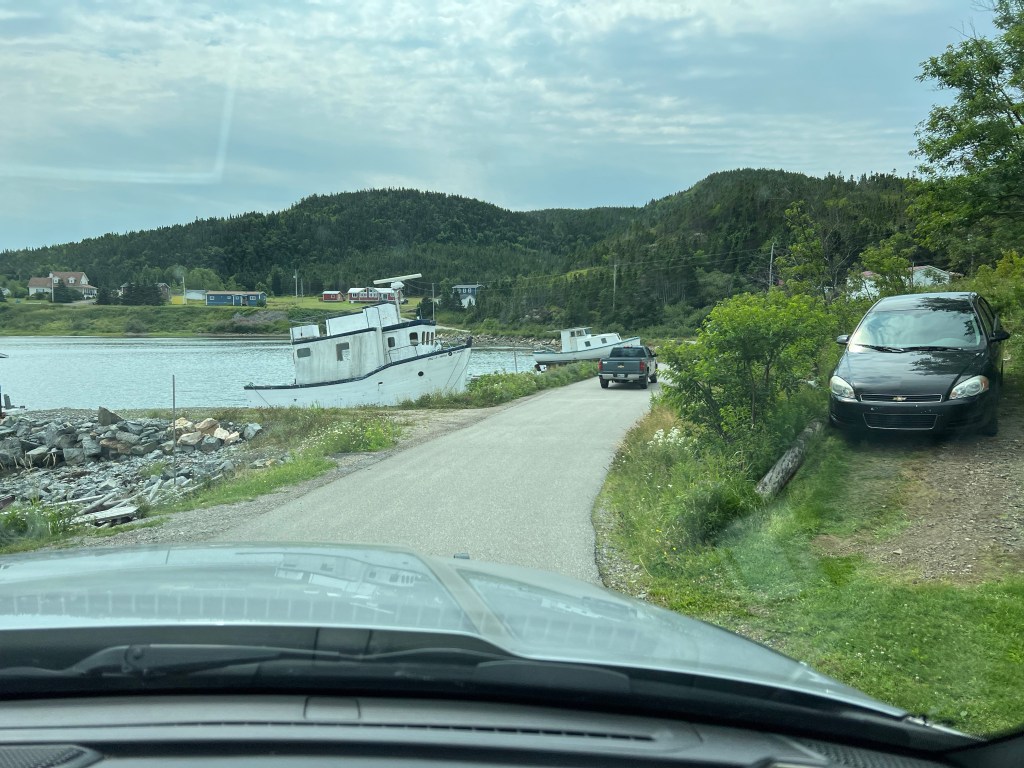
and some old boats. Bud got a haircut and the barber told him a guy bought this old ferry from the government and then basically abandoned it here. The town and the owner of the dock are trying to get it removed.
This is so Newfoundland I had to take a picture.
And any town that’s more than a hamlet has a Great Canadian Dollar Store.
Today was nice so we got to explore a bit more. First we went to Glass Beach, which was just that. A beach with so much beach glass that it outnumbered the gravel.
I don’t have any explanation for it; there was a poem on the sign to the little trail down about tides and currents, but it seems there should be more to it than that.
We then went to the nearby town of King’s Point where we visited their Whale Pavilion. They have the complete skeleton of a humpback whale. I couldn’t find the sign that said how it had died, but the townspeople all helped to clean the bones and configure the skeleton under the guidance of a famous animal behavior scientist. He had come to Newfoundland to study something other than whales, but ended up spending the rest of his career studying and championing whales.
While there we asked directions to the trail some folks told us about to this falls on Rattling Brook (love the name). We’re headed in the right direction.
Of course there was a beautiful and well made trail.
It first took you to a lower viewing platform.
Then after going up a lot of stairs…
and along a boardwalk carefully fastened to the hillside…
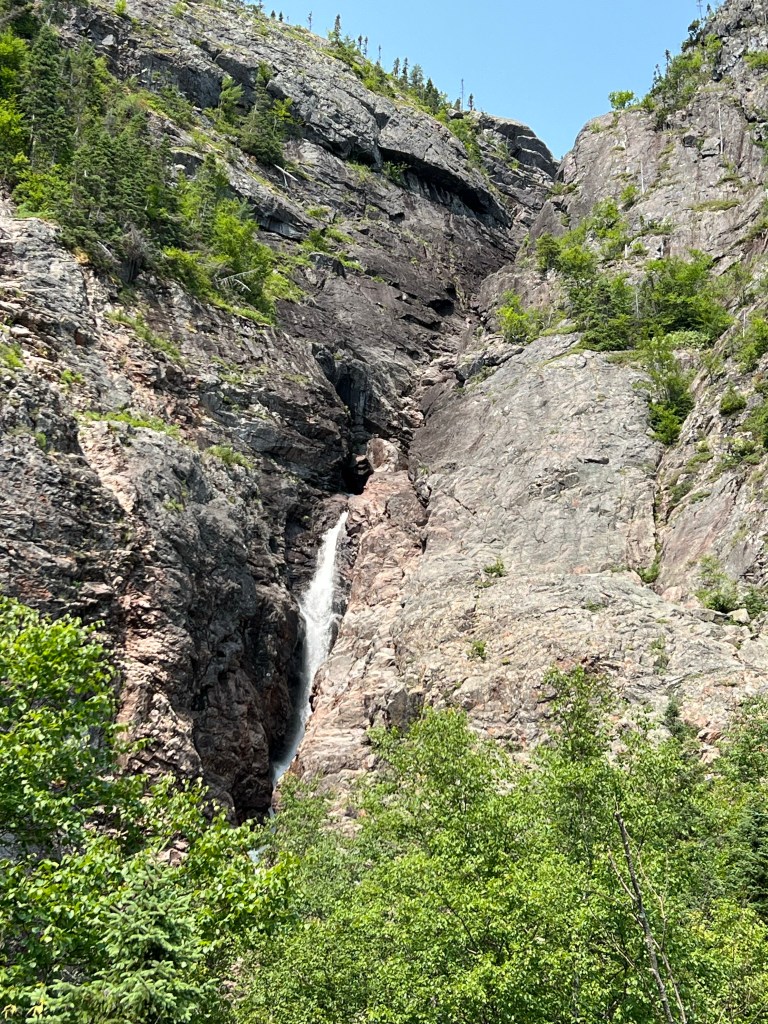
you came to the upper platform where you get a better look at this 850 foot high falls.
Here’s a close-up of where you can first see the water. It’s in two columns above this and they join and pour down here.
And here’s Rattling Brook as it flows under the road…
and out into Halls Bay.
Our last stop was Harry’s Harbour. There were some docks and some houses,
a library,
a beautiful coastline….
and, of course, a hiking trail. It was enticing, but we didn’t think Matey could handle the stones or another walk. It was a fine day anyway.
Yesterday we decided to drive to the end of Route 364, a branch off the road we came down on. It was on my map program as a route, but our paper map said the last bit was gravel.
Okay, not so bad. There was a warning sign that this road was not maintained by the Department of Transportation, use at your own risk. We’d been on those before.
This is where we turned around. We’d crawled up two hills in four wheel drive. The map program said we still had five miles to go.
There was nothing around us and no cell coverage.
It was a long walk back if we got the truck in a situation we couldn’t get out of.
So we didn’t drive to the end of Route 364.
On our way out Bud had seen a nice little bridge. He wanted to try going that way. I told him I thought it was a walking trail. He said there was a road. I said it was a trail. I said it will be a long way to back up if it is a trail.
It was a trail.
It was a long ways to back up. And you don’t drive off the edge into the field because it’s probably a bog and you’ll sink to the frame.
So we didn’t get to drive over the little bridge.
But we did get to see more of this country in the sunshine.
It’s worth the drive.
It’s huge and empty and very striking.
I was trying to catch this where the cliff was closer to the road, but trees made it hard. Our altitude here is about 500 feet. That’s sea level down below.
We stopped at the overlook for the mouth of the Connaigre Bay. One of the resettled communities, Great Harbour, was just on the other side of the point. For public services and supplies folks came by boat across the bay to a cove below this point, then took a path into Harbour Breton, about three miles. No wonder they agreed to move where life was a bit easier.
But we didn’t actually get to go to Great Harbour.
Today we decided to take the passenger ferry and go to Gaultois, one of the outport communities still accessed only by boat. The ferry was at 2 PM. We left in plenty of time. It took a bit to find the right wharf in the little town of Hermitage, and then to find a place to park. Still, we were at the wharf at 1:40.
That wasn’t soon enough. They had their allowed 20 passengers. They pulled the gangway in as we walked out on the wharf and told us sorry, we are full.
They were underway at 1:45 without us.
So we didn’t get to go to the outport of Gaultois.
We saw this boat with a huge reel on it…
and this one with what looked like a vacuum system. We are pretty sure they are both used in aquaculture.
There is a lot of aquaculture here. These rings are in a fresh water pond, but we’ve also seen them in the salt water bays. They raise salmon and mussels. But Bud asked about a retail seafood store in town and there isn’t one!
So we didn’t buy any fish.
But there are always nice trails. So we came back to Mile Pond and took Matey and the stroller around the pond.
This is a pretty big pond.
At least two thirds of the trail was boardwalk so it made pushing the stroller easy.
Here and there along the trail were little fairy towns…
and collections of painted rocks. It was fun.
We came to one spot where there was a ramp up to the trail from the bog…
and then down to the pond. It took a minute, but then it dawned on me, that’s a snowmobile crossing!
No matter what you can pretty much count on a nice walk on a well made trail in a beautiful setting.
TransCanada Highway One makes an upside down U across the island of Newfoundland. Between the downward, and coastal, legs of this U there are exactly three paved highways south (outside of the eastern and more populous Avalon Peninsula). We are now at the end of the middle one, Route 360, the “Road to the Coast of Bays”.
It was a long way down. We drove 230 miles from Terra Nova National Park and never passed a stop sign or signal light.
127 miles of that was south on 360 and we didn’t even pass through a town.
We were hoping to see moose and caribou. I saw just one moose munching in the deep ditch by the highway. But we did see a lot of wide open beauty.
As we approached our destination both the weather and the topography changed. This is our first glimpse of the head of a bay, Hermitage Bay, and we are still over 20 miles north of our destination. It was cloudy, foggy and 10 degrees cooler than Terra Nova.
We were now going up and down steep hills as we crossed from Hermitage Bay…
across an arm of Connaigre Bay and finally to Deadman’s Cove on the ocean side of the town of Harbour Breton. We set up camp in the cloudy damp.
The sun was bright this morning when Matey and I went out and walked along the coast.
We didn’t go very far along this extremely well made path.
But we did see this lovely beach…
and just feet from the slope to the beach is this bog which stretches to the hills behind.
I haven’t learned why this is called Deadman’s Cove, but there are three cemeteries just outside the rv park. With all the boldly engraved headstones and bright artificial flowers these are hardly spooky.
A bit later all of us went back out. We went the other direction where there was a pavilion…
and a path and steps down to the beach.
First we walked out on the rocks where we got a nice view of the coastline,
which was pretty rugged in both directions.
We went down on the beach and the sand was pink and black and dotted with little jellyfish.
The edge was something like a cross between sand dunes and cliffs.
Next we drove to another short trail that led to the lighthouse at Rocky Point. We are now looking at the bay of Harbour Breton.
My friends the larches were growing here…
and there was another bog.
It was a small lighthouse…
but there were big views.
The open ocean is actually behind us here, reached through a channel on the right of the photo.
To our left the channel winds back to the town of Harbour Breton.
We came back for lunch to our very private camping spot at Deadman’s Cove RV Park.
After lunch we left Matey in the trailer and went back to town to the Sunny Cottage Heritage Centre.
The house was built in 1909 by John Joseph Rose, a wealthy merchant. He and his wife had no children so the house went to their nephew, Jack Stewart.
Our tour began in the old kitchen. A young woman was to be our tour guide but she wasn’t back from lunch yet, so we started the tour with Jack Stewart’s granddaughter. She grew up in the house. She remembers this old stove and the day bed off to the right which was used when the house was full of her and her siblings.
Most of the house remains original, including tin ceilings and chandeliers like this one in the downstairs hall.
Our official guide joined us here. She said I could open the front door, which isn’t used, to take a picture of the view they had of the harbor.
The dining table and chairs are the originals…
as are the dishes in the cabinet.
The drawing room was beautiful with its striking tin ceiling…
and original fireplace. I liked the inlaid ceramic hearth. Many items in the house were donated by members of the community. Some are from the Rose and Stewart families, others are just nice period pieces.
The house is three stories high with a central stairwell. The railings were all short because Mr. Rose was short.
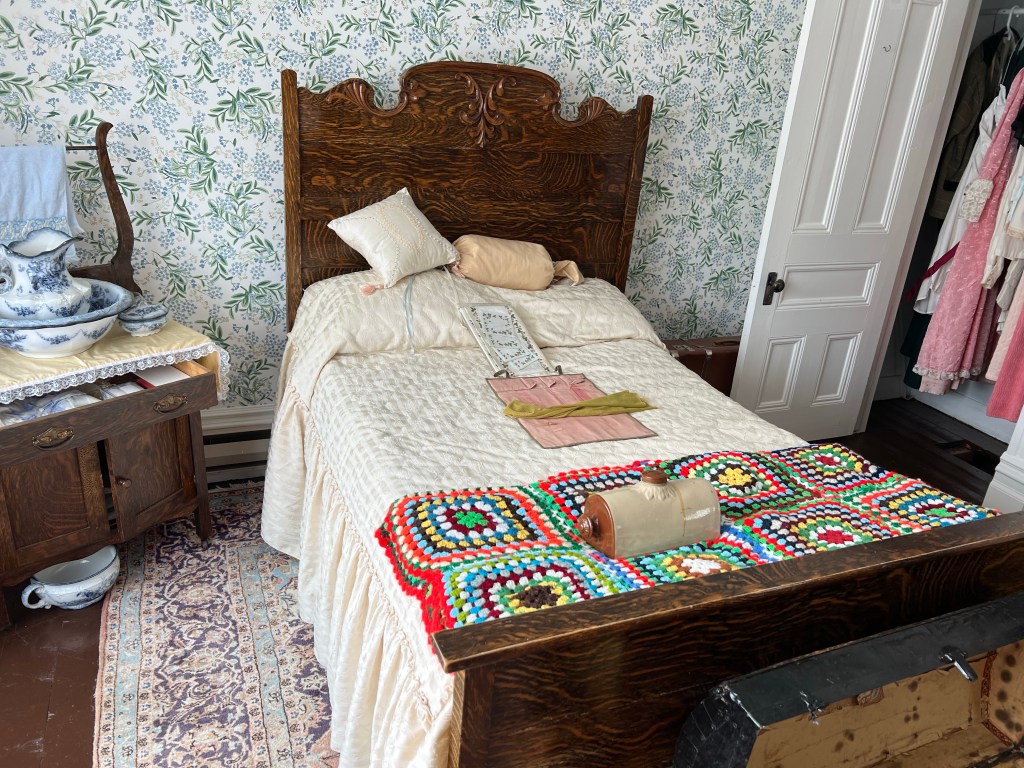
This was the Stewart’s bed…
and in the nightstand drawer is the nightgown worn by Mrs. Stewart on her wedding night!
In what had been a third story storage area they had some items from the community. My favorites were this first barber chair…
and this old outboard engine.
One of the rooms on the second floor was dedicated to the resettled communities. In the 1960’s the Canadian government paid people in remote communities to move to one community in the region. Harbour Breton was selected to receive resettled people. This is a closeup of the large wall map they had in the room. Each red pin is a community that is no more. Harbour Breton is the blue pin.
The room was filled with pictures, documents and artifacts from those resettled communities. This personal local history touches me.
We have a couple of more days to spend in this beautiful area. Perhaps we can find the site of one of those little fishing villages that is no more.
This is the only picture I have from Friday. These are the stairs down to the southwestern side of the campground trail. Rain was ending at nine or so, then it was going to get hot (up to 82 degrees F). So as soon as it stopped raining I took Matey here. I wanted him to have a good walk before the heat, but he was reluctant to take the trail. I had to repeatedly urge him down until we were on the path below and walking towards Big Brook, which you can see in the distance. It began to mist, which didn’t worry me. When we were just about half way on the trail the mist turned to rain. Bud called to ask if we needed to be picked up. He came, but the closest he could get with the truck was about 80% through the hike. I was literally soaked to the skin. Only my feet were dry because my hiking boots are water resistant. I think Matey knew.
I put on dry clothes and the day became a work day, even though the rain stopped in an hour or so. I did the laundry in the morning. I had mentioned the night before that we might try to clean the coils on our main air conditioner. That meant me going up on the roof. Dennis asked if I wanted help. I told him if he really wanted to I would gladly accept his help, but not to change his plans on my account.
He came and we did it. Bud was ground crew. It was a bit more involved than Bud had described from the YouTube video he’d watched. I was glad Dennis was there to help us decide what to do. The four screws you needed to remove became about fourteen. The foam cleaner did its thing, it didn’t look too bad to start and we’re not sure how much it improved the efficiency, but the coils are clean.
In the evening I took leftover shrimp and grits that Bud had made for our dinner to let the Newfoundlanders try a bit of southern cooking. We had a great time chatting. This morning they left, but Florence and I exchanged cell phone numbers and they said the next time we’re in Newfoundland we need to visit them at home. Hope we do someday.
Today Bud took Matey and me to the government wharf for our morning walk. We finished the Coastal Trail walking the section from there back to the campground. This part of the trail was far less used.
Where light got in it was almost overgrown. It was still easy to follow and the steps and boardwalks were there where you needed them.
And of course it was beautiful.
It had views of the sound…
and a section of beach that had the famous National Park Red Adirondack Chairs.
It was cool and still and gorgeous.
I know I’ve posted at least a hundred pictures of beautiful Newfoundland trails. I am still amazed by them. Sometimes I feel like I’m walking in the Shire from Tolkien’s books.
For people here walking is a part of life and they have and share their trails everywhere. It’s definitely my kind of place.
Unfortunately by the time Matey and I got back to the campground Dennis and Florence and Maxine and Barry were gone. I do hope we get to see them again someday.
This afternoon we took a drive to Dover. They had a short trail to this overlook. It was only 0.4 mile but since Matey had walked almost two miles this morning and it was again over 80 degrees we put together the stroller for him. We took him up the boardwalk and a few flights of steps.
When we got to the final flight we decided to park the stroller and let Matey walk.
There were wonderful views…
in all directions.
But the thing we came to see is this. The notch you see in the hills across town is a fault. This fault developed some 410 million years ago when tectonic plates from two continents came together. The land on the left of the notch was from the ancient continent of Gondwana (Africa and Europe). To the right of the notch is land that came from volcanic eruptions in an ancient ocean and became the edge of North America. The eastern part of Newfoundland is land that broke off what is now Europe and Africa. The western peninsula is part of ancient Laurentia, which forms the core of North America. And central Newfoundland is from the volcanoes in the ancient ocean.
We drove into town and the street through the notch was Fault Drive.
Again, Newfoundland is a geological wonder.
Our final stop in the area was back in the park at Ochre Hill.
There’s an old fire tower here that you can climb nearly to the top.
All of Terra Nova is laid out in front of you.
The body of water in the upper right is Newman Sound; the campground is there.
Wednesday there was a chance of showers all day so we puttered around the trailer, went to the little town nearby and stopped at the Welcome Center. It still hadn’t rained and I was getting antsy so I decided to take Matey and walk partway back along the Coastal Trail. Bud said he could pick us up at the Government Wharf which was supposed to be just 2 km along the trail.
It was another nicely done trail…
with just enough structure to protect you and the woods.
We’re getting in to summer here, the creeping dogwood has berries…
and wild roses are in bloom.
The bog laural is still blooming, though.
This is the Coastal Trail and I got some peeks at Newman Sound.
Then the trail took us down on a slip of beach…
and Matey took advantage of that to cool off. It was over 80 degrees here Wednesday and today.
Coming from the beach we got to go up this fern lined boardwalk.
The walk was closer to 2.5 km than 2 km. Bud started wondering where we were so he came walking back and met us.
This is Government Wharf. It has a pretty nice boat ramp…
with some lawn and picnic tables.
There was supposed to be a falls, which we hadn’t seen. It was impossible to miss where the trail went as it crossed the paved area.
Not far on the other side we found the falls.
I felt better for getting a walk in and we never did get rained on.
Today we decided to go back to Skerwink Trail. Last year we hiked it but saw no whales. We were hoping they would be there this year. We arrived a bit before 10 AM and there was still quite a bit of fog around. The first part of the trail is a bike path and I took Matey in the stroller for just under a half mile.
When the bike path ended we left the stroller next to some bushes just off the trail.
It was still a nice path, but not stroller friendly.
We got to the cliffs and little beaches where the whales might be. There was good visibility along the shore but no whales.
It is still a beautiful walk…
among the most gorgeous places we’ve been.
We went a bit further out than we went last year but still didn’t go all the way to the head as the fog was blowing by and we knew there would be no viewing of any kind out there.
Besides, by the time we negotiated all the steps back…
and looked at the beaches from the other side (still no whales)…
Matey had had enough and was happy for a stroller ride.
This was back towards the start and end of the walk, what a beautiful place to live!
Dennis’s sister, Maxine, told me that if we were out there we really should drive around to the little town of Trinity, on the other side of the bay.
It’s one of the oldest European towns in North America and has many old buildings.
It was very pretty.
There were a lot of historical buildings, many painted bright colors.
I could easily have spent a couple of hours walking around.
I think you could tour a number of these quaint houses.
Here’s another unique Anglican Church. (I still like the one at Burnside better.)
Bud and Matey were both tired so we just cruised through and I snapped whatever pictures I could.
So things aren’t quite centered.
There were just so many picturesque buildings.
This is looking across the bay to the peninsula where the Skerwink Trail is. It’s still shrouded in fog.
This is the lighthouse, fog still streaming by. While we were on the trail we heard the foghorn from this lighthouse sounding.
After our too quick tour of Trinity…
we drove back through more beautiful countryside. We detoured a few miles to Clarenville to stop at a store and didn’t get back to the trailer until almost four o’clock. Another full day of beauty.
At the end of the peninsula just west of us is the little town of Salvage. The guidebook said there were trails through town so we thought this might be a good place to go and walk. We have a dog stroller for Matey (it was originally our daughter’s for her dog that went lame) and we figured if he got tired we could let him ride.
It worked to some extent. Matey walked along and Bud pushed the stroller until Matey had enough of peeing and sniffing and seemed to be getting tired. Then he rode. We took the stroller down the main drag in town to the far side of the harbor.
We walked by the wharf. There was an interesting looking cruising sailboat tied up, it reminded me of Earendil. I would have liked to go out to inspect it more closely, but unauthorized folks were not allowed on the wharf.
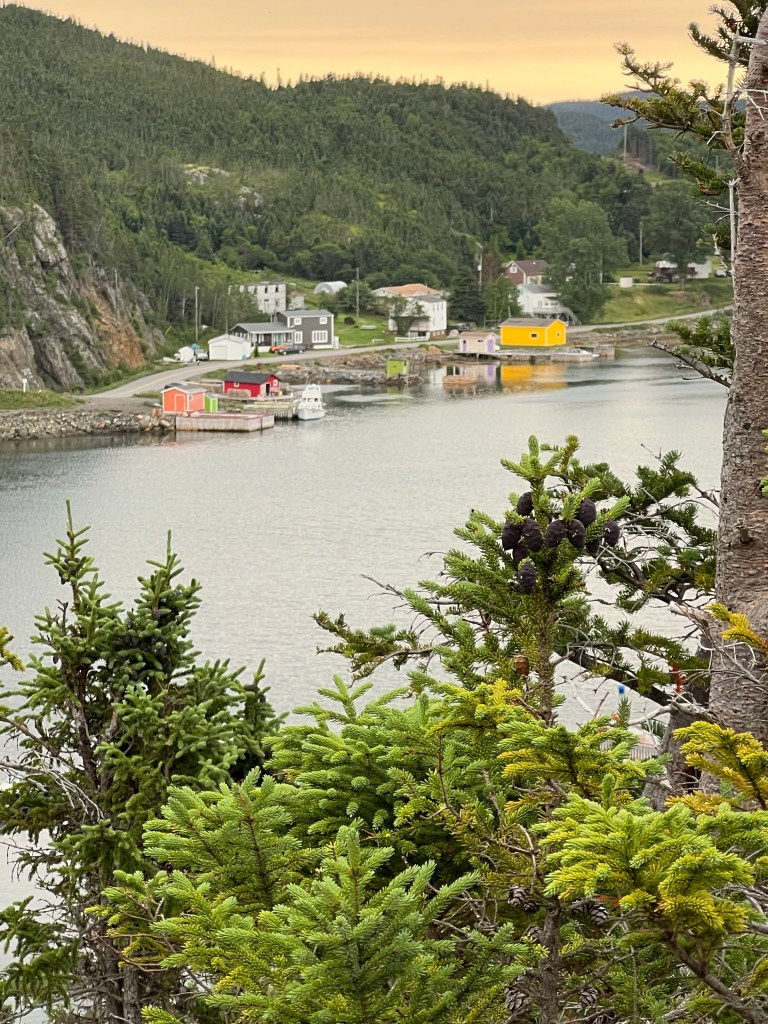
It certainly was a beautiful little harbor.
The harbor was bisected by this spit of land.
Past the wharf the road ended, but the trail continued. The stroller did pretty well on the narrow path.
We were walking on what looked like an old road. We did not see any road to take you to the house in front, nor to the two houses behind it on Burden’s Point.
We made it as far as the first house, but then your choice was stairs or a very steep ramp. I would have tried the ramp but we’d discovered that one side of the stroller handle wouldn’t fasten securely. I was afraid to pull it up the ramp.
After looking around Bud took Matey back onto a shady part of the trail while I walked up to the rocks behind the house to take pictures.
That’s Burden’s Point and the entrance to the harbor.
And that’s looking across the harbor to the spit of land that bisects it and beyond.
We made it back to the street with no problem. Walking back we saw this house for sale. I looked it up, price is $69,000 Canadian. I think it must have some serious issues. It is a hundred years old, has only one bathroom and is on a septic system. Still…
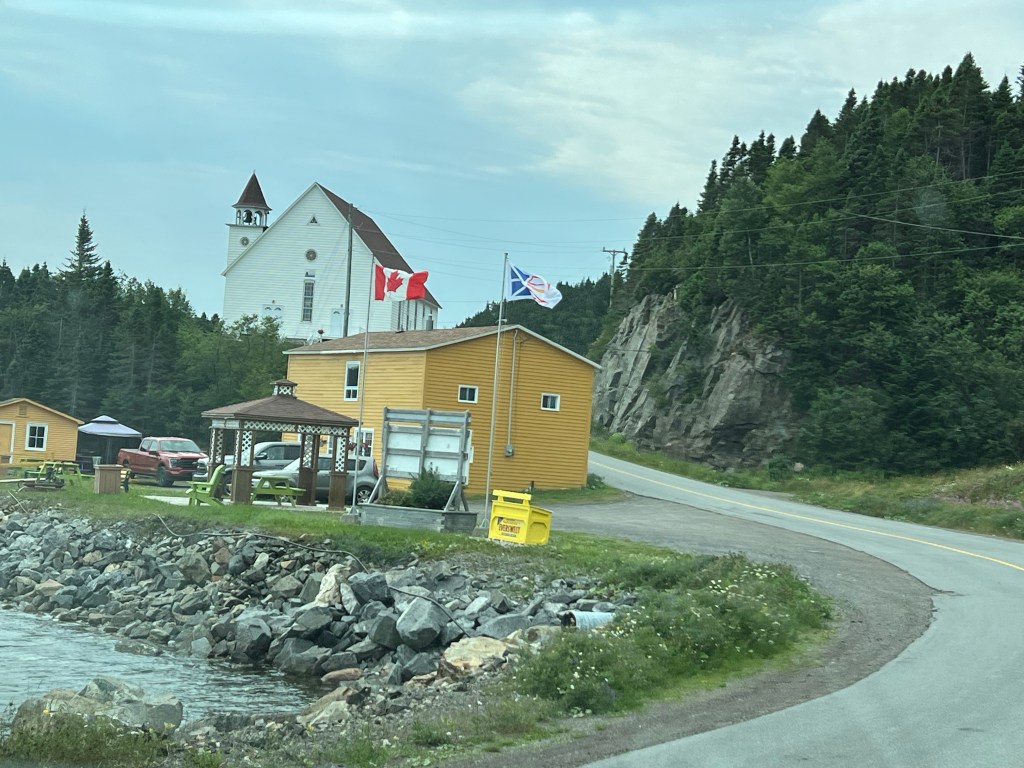
As we were walking back I had to get a photo of these flags. The Canadian flag is on top, below on the left is the official flag of Newfoundland and Labrador. On the right is the unofficial flag of Labrador. I love it. The top two fifths is white, for snow. The bottom two fifths is blue, for water, and in between one fifth is green, for the land. Against the snow is a two year twig of black spruce. The older growth is shorter for the hardships of the past. The newest growth is longer, for the hope for the future. The end is three equal twigs for the three peoples; the Innu, the Inuit and the Europeans.
Bud went back to get the truck and Matey and I continued around the harbor. This place was also for sale. It’s $179,900, 3 bedrooms, 2 baths, built in 1960 and renovated in 2004. The best thing about both places is that they overlook the beautiful harbor. It’s hard to find a house in Newfoundland that doesn’t have a great view.
Matey and I continued out the spit of land that divides the harbor. This is looking back at the house where we turned around earlier.
I got a great view of the two houses on Burden’s Point, the Burden House and the Dunn House. They are also for sale. Built in 1912, comprehensive architectural rebuild, water access, dug well and septic. Two named houses for just $1,200,000; bring your own boat.
It really is a pretty place…
no matter which direction you look.
Bud picked us up down near this yellow house. Another nice location.
On the way back we took a detour to Burnside. I was curious about Cottel Island. There’s ferry service from Burnside to the island, and the town of St. Brendan’s sits out there, but although pretty much every route and every town is covered in the official tourist guide there’s not a word about these places.
We got there just in time to see the ferry leave. There was no one on the ferry dock, so the mystery remains.
We took a drive around Loop Road in Burnside. Oh yes, beautiful.
And Bud pulled in and let me take this photo of the Anglican Church there. It gets my vote for the prettiest church ever.
Last year when we were at Terra Nova National Park we met Dennis and Florence Porter. They gave us some iceberg ice because we had missed the icebergs. They also told us that Bonavista Lighthouse was worth visiting again in the sunshine, which we did, but saw no whales. We decided we would come back this year, and come earlier to see icebergs and whales.
We did come back, and we saw icebergs in Labrador and one whale. This week we’re back at Terra Nova National Park and last night there was a knock on our door. It was Dennis and Florence! Dennis saw us go by when we came in and recognized out Outdoors RV trailer with Arkansas license plates. They are here again, and at the same time we are, even though we are five weeks earlier than last year! Here they are sitting outside Dennis’s sister and brother-in-law’s trailer.
Today we went back to the Bonavista Point Lighthouse, which is getting a fresh coat of paint.
The puffins are still there.
And so are the beautiful cliffs.
But this year, feeding just beyond the cliffs, there were whales! There were three where we were watching here.
Bud was hanging onto Matey while I took pictures because we were out on a pretty narrow piece of rock.
The whales seemed to be moving up towards the lighthouse, so we walked up there. This, I think is a different whale. It and another one were hunting just off the rocks in front of the lighthouse. What you’re seeing here is the top of its head back to the dorsal fin. It’s swimming towards the right side of the picture. They put on quite a show, but I missed some of the best pictures.
When we couldn’t see them any more we walked back down the headland to the truck.
We stopped quite near the lighthouse at Little Dairy King…
for a lunch of fish and chips. It was a perfect day for sitting out in this lovely setting.
We saw a bit more of the town of Bonavista this time.
Bud was in looking for silicone caulk at Swyers Building Center, so I took the opportunity to get a picture of their food store, “Serving You Since 1892”. I was going to wait until the maroon car moved, but since they had just pulled half off the road to stop and chat with friends in a typical Newfie manner, I decided they should be part of the picture.
I caught the United Church as we drove by…
and we stopped here, at the Visitors Centre.
Along the town wharf was this beautiful yawl out of St John’s.
It was an altogether satisfactory day and I’m glad to be back!
Bud and I were going to the Beothuk Interpretation Centre and were not taking Matey so I took him for as long a walk as he would like this morning. We went along the trail here at the park.
I would have loved to go to the end. This sphagnum moss made the woods glow green. But after about a half mile Matey showed signs of flagging and we had to walk back, so we turned around.
We did detour a couple of hundred feet on a path to the beach.
We were well rewarded.
And finding ghost plant or Indian pipe, a parasitic flowering plant, made up for the relatively short walk.
Bud and I then drove just a few miles down the road to the Beothuk Interpretation Centre Provincial Historic Site. This year is the 75th Anniversary of the Confederation of Newfoundland and Labrador as a province of Canada, so anyone with a birthday in 1949 or before got in free. That was me! Bud had to pay the four bucks.
We were pleasantly surprised with how well the center was done. It told the story of the Beothuk people who lived on the Island of Newfoundland for as much as 1000 years before Europeans came. The past generations are named by archaeologists the Little Passage people, after Europeans arrived they were called the Beothuk.
At first the Europeans were seasonal inhabitants setting up fishing stations in the summer. The Beothuk, who probably numbered less than two thousand, simply avoided them. When the Europeans left in the fall the Beothuk scavenged their abandoned camps for useful items, mostly metal, which they then reworked into tools.
The Beothuk relied on the bounty of the sea in spring, summer and fall. In winter many went to the frozen interior and hunted what land mammals there were, though Newfoundland has a paucity of land mammals. There were no moose or porcupines on the island.
Europeans began to settle the shore permanently. The Beothuk continued to resist contact or trade, but did take what was left unguarded. Conflicts arose and the Beothuk suffered. They were pushed to the interior where without the bounty of the sea they starved.
This statue is called Spirit of the Beothuk. It was created by sculptor Gerald Squires who was inspired by what he knew of the Beothuk woman Shanawdithit. Two Beothuk women were captured at separate times, Demasduit and later her niece, Shanawdithit. Each was eventually brought to St. John’s, each was well received and taught the Europeans some of their language and culture. Each died within a year of arriving; Shanawdithit died of tuberculosis, as was probably the case for Demasduit. When Shanawdithit died in 1829 she was the last cultural Beothuk. The people and their culture were gone, though there are probably descendants among the Mi’kmaq people who live to the south.
The statue sits about three quarters of a mile from the Interpretation Centre along this very well made trail.
It sits in a beautiful little glade…
just before the Beothuk village archeological site.
The discovery of this site is the result of the research and effort of Dr. Ralph Pastore. He was looking for sites that might shed light on the history of the Beothuk and the reason for their extinction. There were no missionary or government agent records on these people.
This site is in a protected cove with a small beach where canoes could be landed,
it has a freshwater creek,
and the site itself is a glacial moraine, filled with gravel and rock left by a past glacier. Unlike most of the boggy, stony land around it, it would drain after a rain. 16 likely sites were identified in this part of Newfoundland, two turned out to be from the right era. This was the largest.
Only four of the eleven dwelling sites were excavated, enough to show who lived there and when and answer some of the questions on how they lived. The rest are left for future archaeologists with future technologies at their disposal.
We’ve been to a number of archaeological sites in North America, but the presence of the statue and the story of the women made this site more relatable.













 On the Roam Again