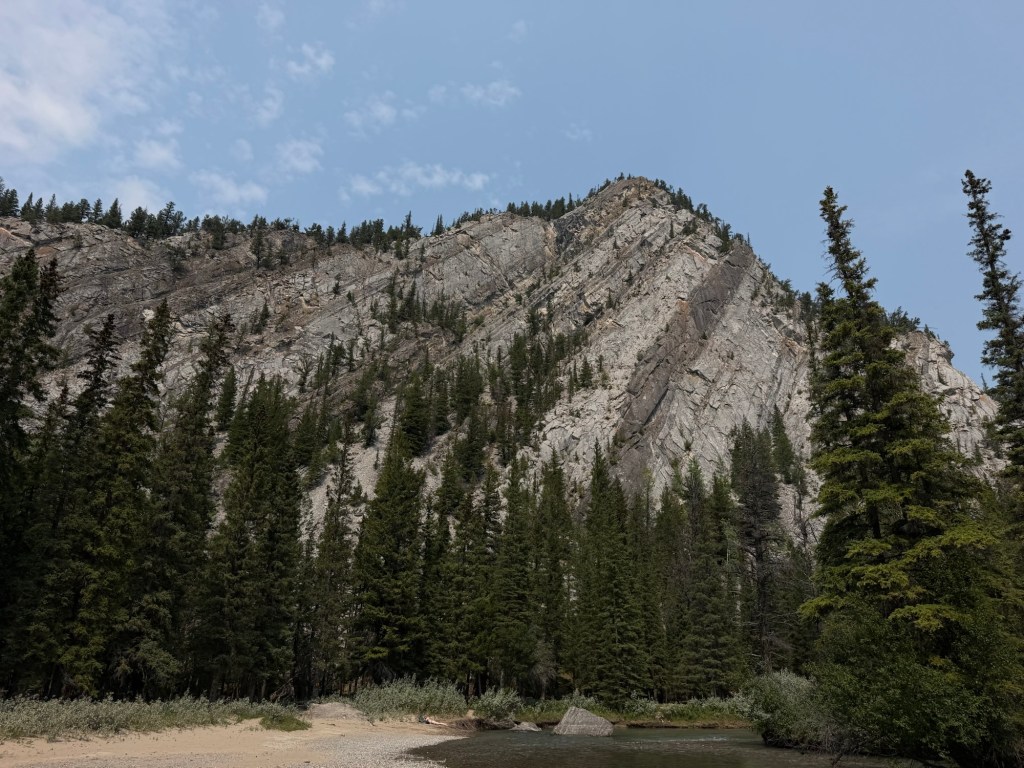
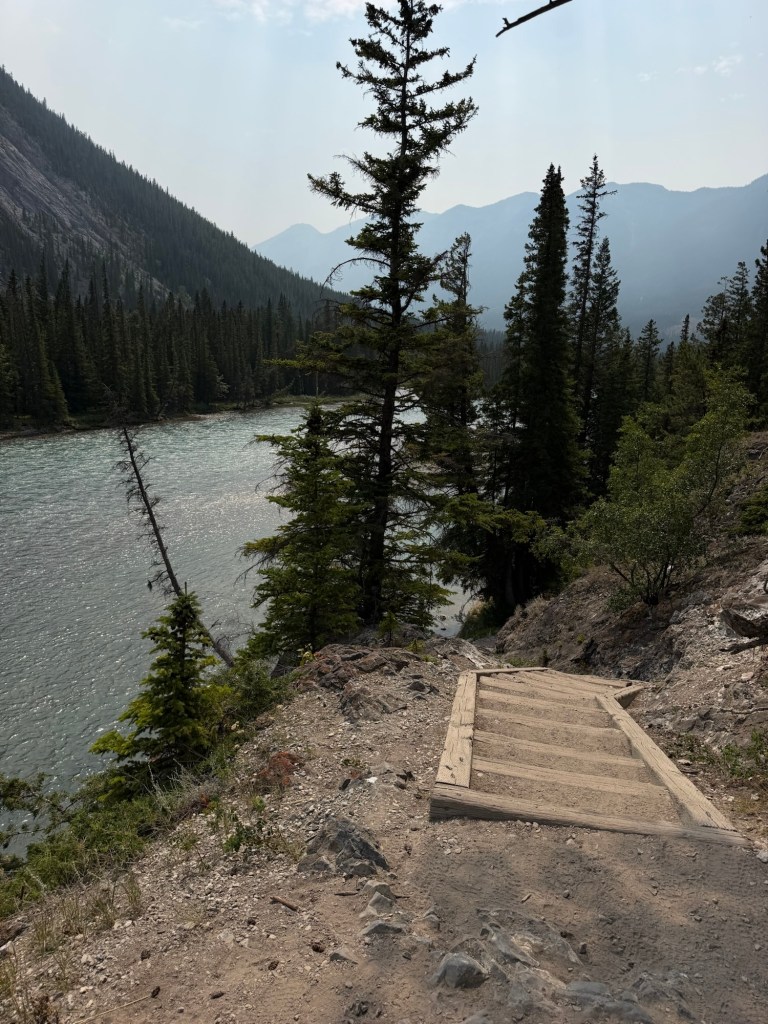
We’re at Riding Mountain National Park in Manitoba. And this isn’t a bad site because of the park.
We like the park,
even though it’s only a mountain compared to the flat land around it.
We even like the campground, it has large sites with a good deal of privacy.
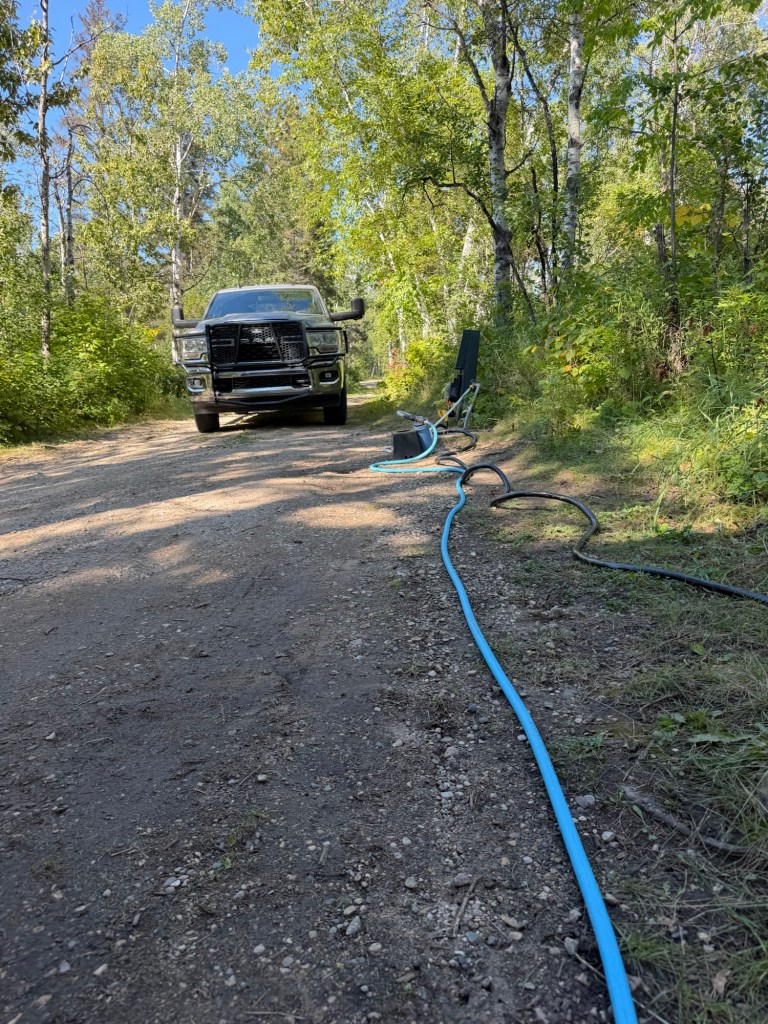
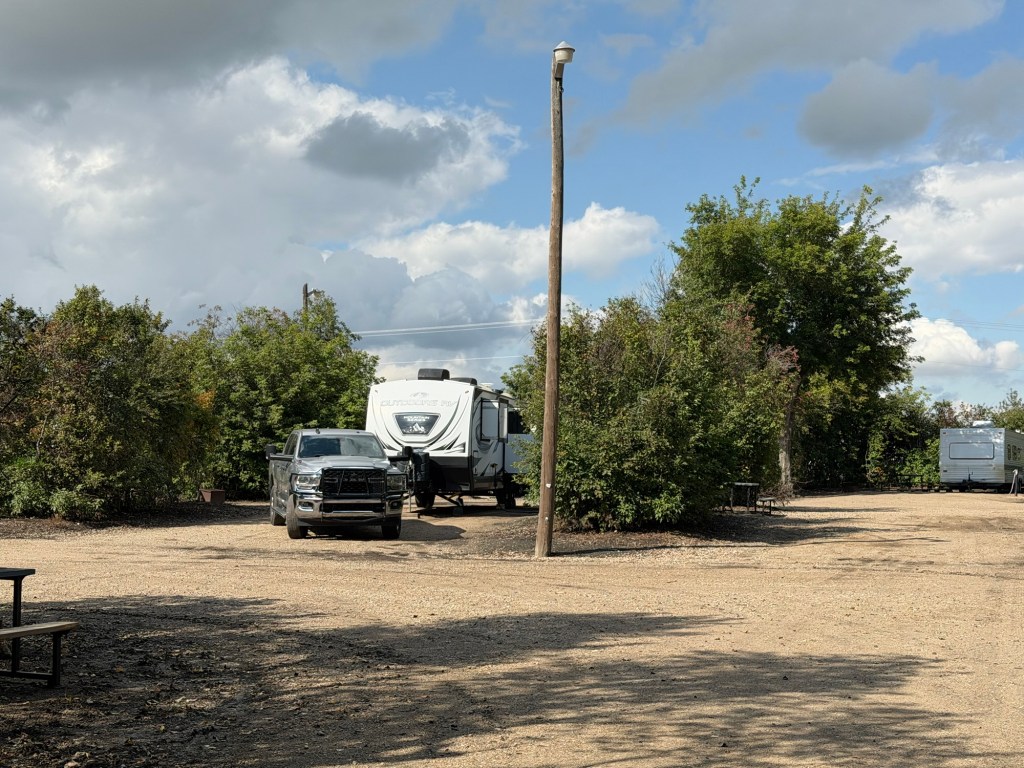
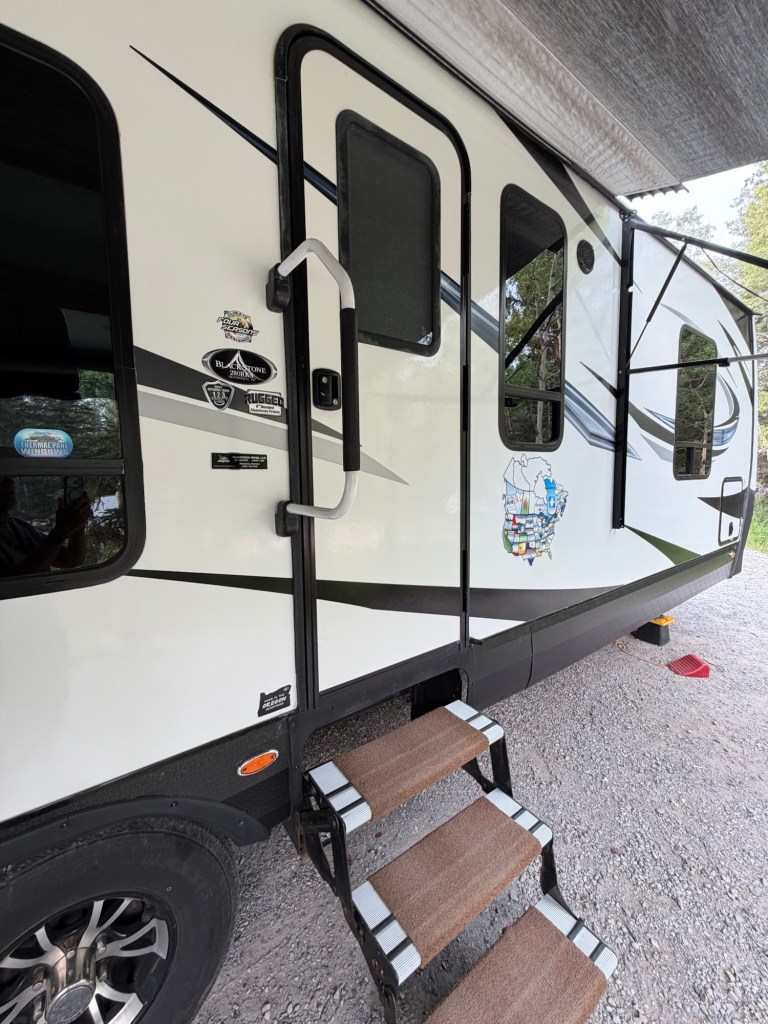
It’s our particular site that is so bad. It doesn’t show up too much in the photo, but our nice pull through site with full hook ups has a dip in the middle.
And it is so slanted from side to side that we had to pull the trailer forward and far to the left to find a spot level enough…
to get it level with our supply of wheel blocks.
It’s so far to the left that we can barely access the storage cubby, electrical hookup or forward tank drains.
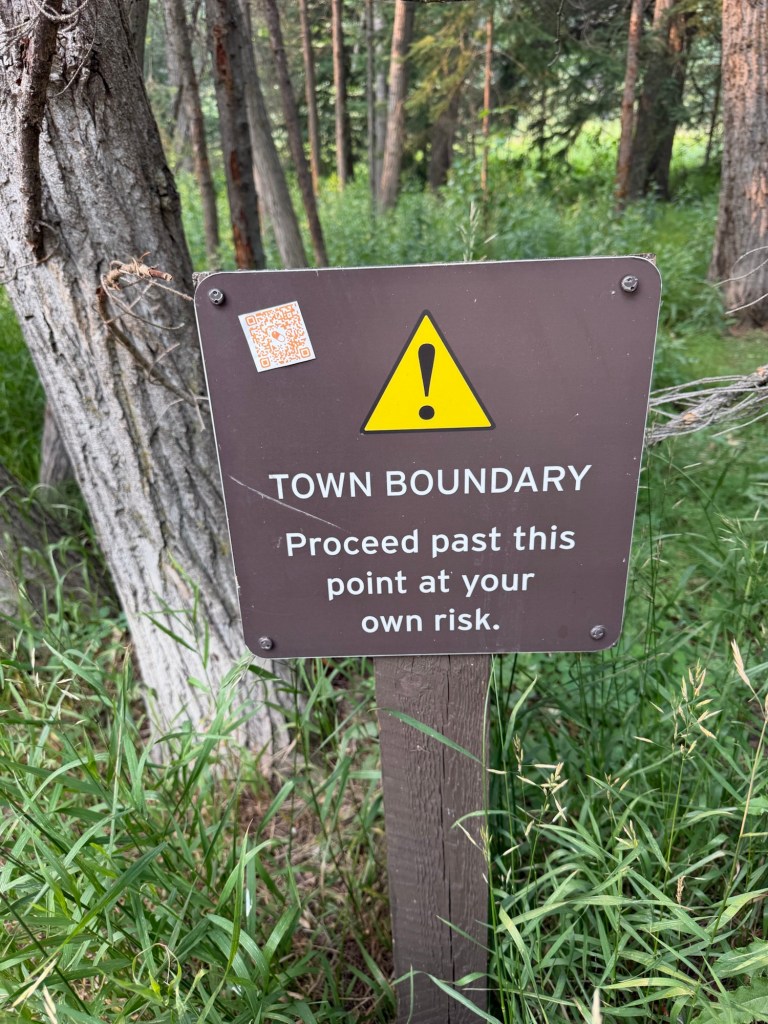
And it’s so far forward that our sewer hoses won’t reach back to the sewer opening, which is back by that post. Worse, since the site has a dip and the trailer is in it, even if we had an extra hose the drain is above our tank outlets.
I booked us here for a week because we had sewer, but today we had to use our portable tank to drain the toilet water, ugh, and the shower water. We wouldn’t have had to drain the toilet tank, but we didn’t empty it at our last park because we had sewer at the site here.
And we had to hook the portable tank up on the right side of the trailer and toss the sewer hose under the trailer. I then climbed through the wild rose bush to get at the tank drains. I fished the hose out from under the trailer and hooked it up. Of course I couldn’t see how full the tank was, so Bud had to tell me when to shut the valve. He also had a valve near the tank. We added shower water after the toilet tank drained. Bud told me to shut the valve, but then the hose under the trailer was full, in fact the pipe from the tank valve to the hookup point was still full, so when I tried to take the hose off and cap it so we could pull it back under the trailer and empty it the water from the pipe came out on my foot. At least it was just shower water.
Anyway, it was a mess and it took two trips to the dump station to get it done.
So, nice park, good privacy, but almost the worst site ever!
I’ll do another post about the rest of the park, but this site deserved its own post.
We made two more stops in Saskatchewan. The first was almost directly south of Prince Albert National Park, just east of Saskatoon at Painted Rock Campground.
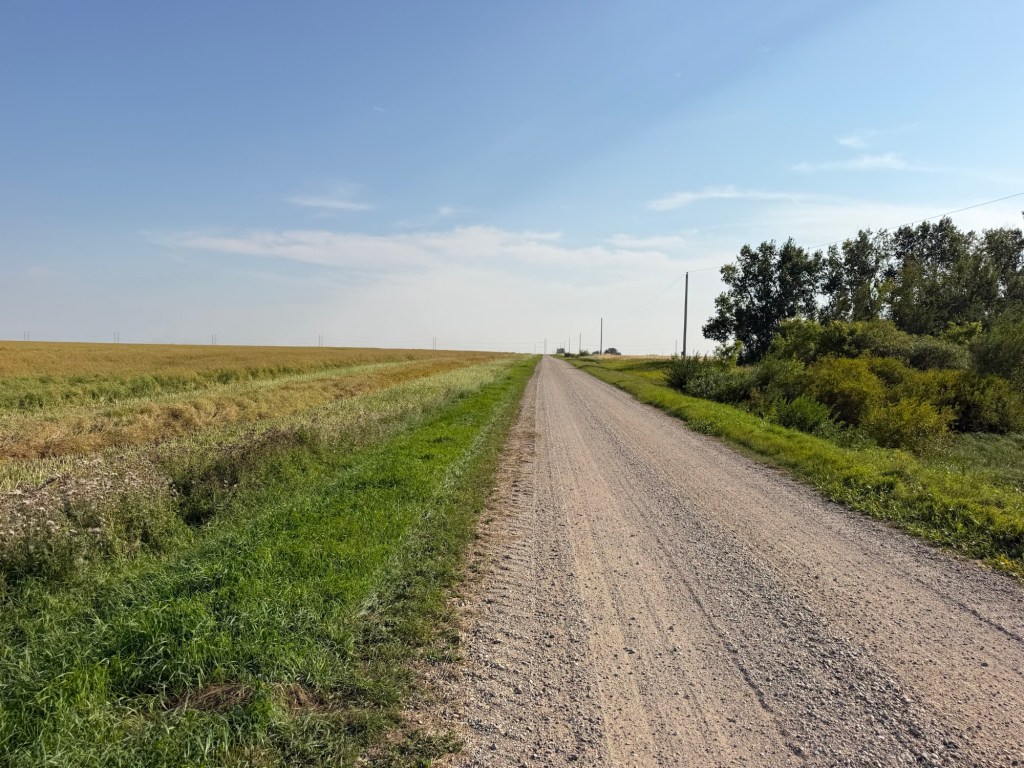
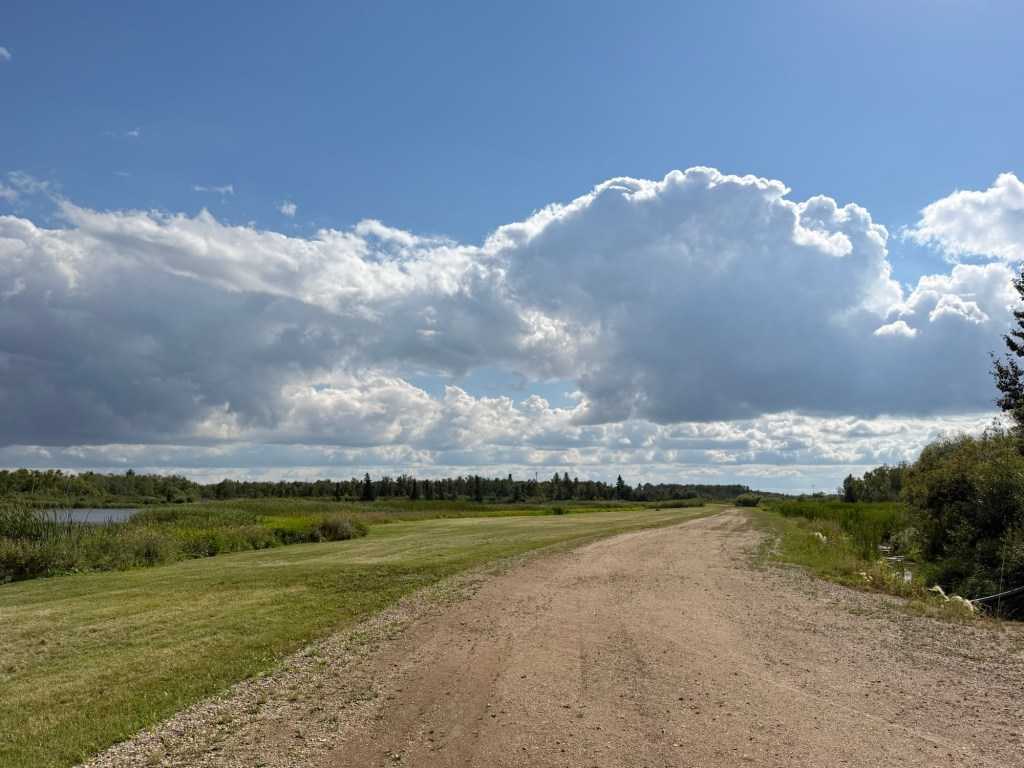
I don’t think I’ve been in country flatter than this. I took a walk south on the dirt road where the campground is.
Further south there was a bit of lower land holding water.
Looking east…
and west there was nothing but flat as far as I could see.
So I turned back north.
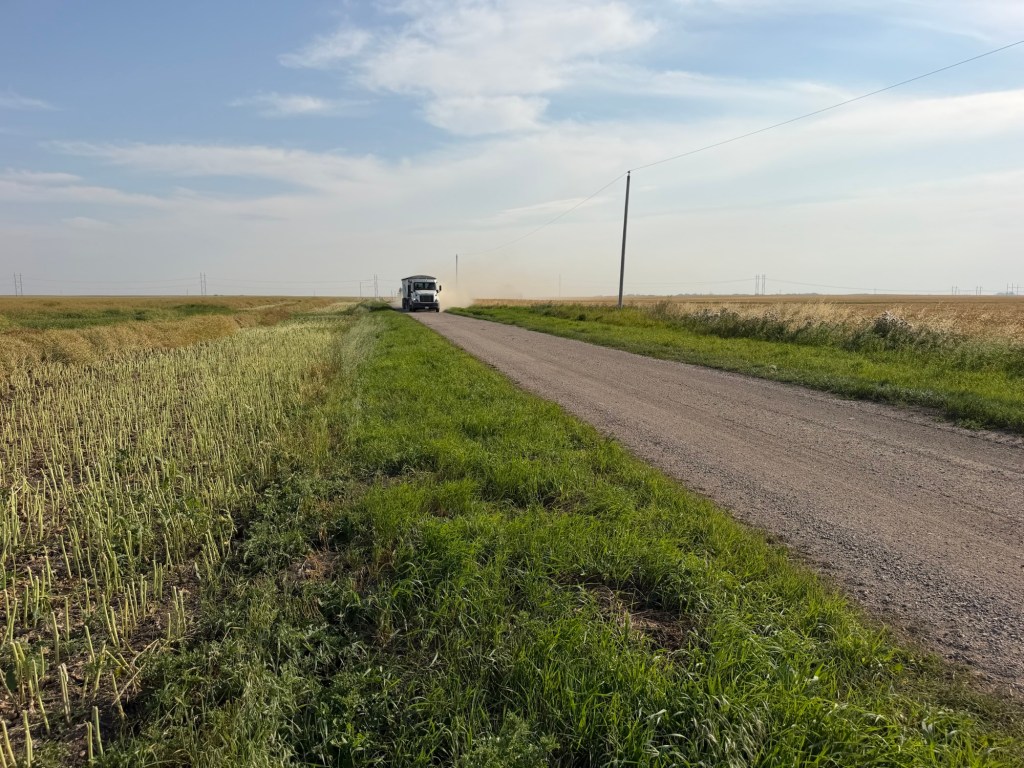
They were harvesting grain and this huge grain truck went past me.
I had the good sense to walk over to the upwind side of the road.
The campground itself was pretty nice. Our host told me they’d had a cool wet summer and they were having problems with fungus in the crops.
I liked their entrance arbor. We were able to order and pick up a new microwave in Saskatoon, as ours died. It’s amazing how dependent we’ve gotten on that device. And our kind host also let us have the paperwork delivered here so Bud could do a remote renewal of his driver’s license. It was waiting for us in his safe. We had to take it into Saskatoon where Bud had an appointment at an eye doctor for the eye test. Then everything got mailed in. Definitely worth the stay in the flatlands.
We then made a quick stop in Yorkton at their city campground.
Here I was able to walk to a nearby ecological center.
They had this floating bridge across the little lake…
and I got a nice shot of the lake and the almost stormy sky.
Yorkton also had two disc golf courses…
in adjacent parks. We combined them to play eighteen holes.
We were still in the flatlands, but we had some fun and were able to stock up for our next stop at another National Park.
We stayed four nights at the Red Deer Campground of Prince Albert National Park, which is on Waskesui Lake in northern Saskatchewan.
As we are finding with many of the Canadian National Parks, a central area of the park has been developed as a resort to provide ordinary Canadians a recreational getaway. This is the main beach.
The Waskesui Townsite has many privately owned cottages. The park regulates the square footage and as this is highly desirable real estate places with under 900 square feet sell for around half a million, USD.
There’s a small commercial area…
and a beautiful golf course designed by Canada’s famous Stanley Thompson.
The clubhouse was built by relief workers in 1934 (similar to the CCC in the U.S.).
We never got a chance to play as they were holding a women’s tournament all week. Tee times were only available late in the day.
For all the development this is still a National Park with thousands of acres of forest around.
These young elk were checking out the grass in the campground.
They were pretty relaxed among all the campers.
We took a hike at the north end of Lake Waskesui along the short Kingsmere River.
These steps took us down to the river and bridge.
On the other side of the river was the rail cart portage.
A dock with rollers allows people to pull small boats up and onto carts.
We met these two with their boat coming back down the portage,
so we got to see the rail cart in action.
The rails went close to a half mile from the upper dock to the lower.
Not far from the end of the portage was Kingsmere Lake.
There are five or six campsites on the lake, but we just walked as far as the first one, Southend.
Another hike we took was to Height-of-Land Tower. This 45 foot tower gives a view over the vast forest here. This is the edge of the Boreal Forest where spruce fades into aspen and then to fescue prairie. The tower sits on the divide between the Churchill and Saskatchewan River systems.
We drove up the west side of Lake Waskesui to the Narrows, where the channel is only a hundred yards or so wide.
Nearby was the Treebeard Trail where some of the oldest trees in the park can be seen. The tallest trees in this harsh northern environment are no bigger than young Redwoods.
The aspen and paper birch do reach astonishing heights for their slender girth.
I was a bit dissatisfied with the Treebeard Trail, but later I hiked alone on the Boundary Bog Trail and far preferred that. It started with a wide path through black spruce with an understory of moss.
That led to a boardwalk through a bog…
to one of the many little lakes that dot this country. I learned that the depressions we had been seeing all over, some water filled and some not, are called kettles and they formed from ice chunks that broke off the retreating glaciers. Sediments built up around the ice and when the ice finally melted the resulting low area is a kettle.
There were acres of sphagnum here, and some was turning red. I wanted to identify these little berries, but haven’t been able to, yet. My Apple ID app thinks they’re bugs.
Altogether we enjoyed our stay in this not so wild north, though the mosquitoes here were voracious.
Silver Lake Regional Park, our current location, is about halfway between Edmonton and Saskatoon and pretty remote. It’s over the border into Saskatchewan and we thought we’d be loosing an hour coming into Central Time. Not so. Saskatchewan is always on Standard Time, so though we’re in the Central Time Zone, it’s Central Standard Time and is the same as the Mountain Daylight Savings Time of Alberta. In fact, Alberta is on permanent Daylight Savings Time, so the two provinces are always at the same time.
We have a decent spot, made better because the trailers on either side of us are empty.
I’ve taken a few walks. This is Silver Lake.
Down across this footbridge…
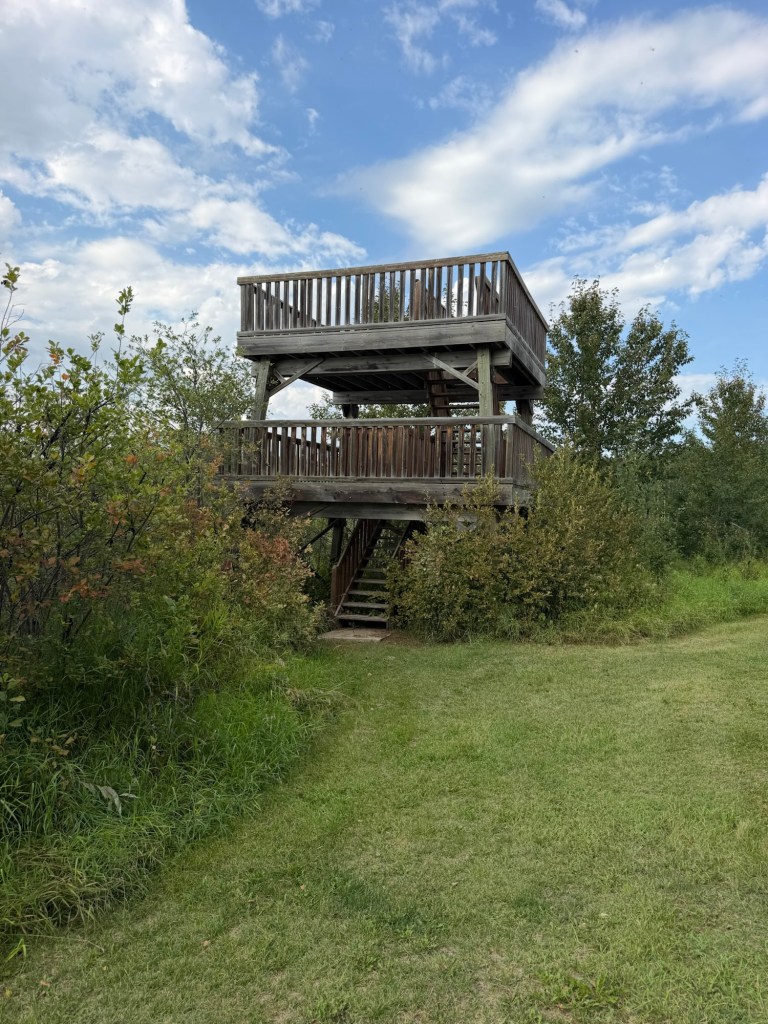
is a bird viewing platform.
This park is in the Big Gully,
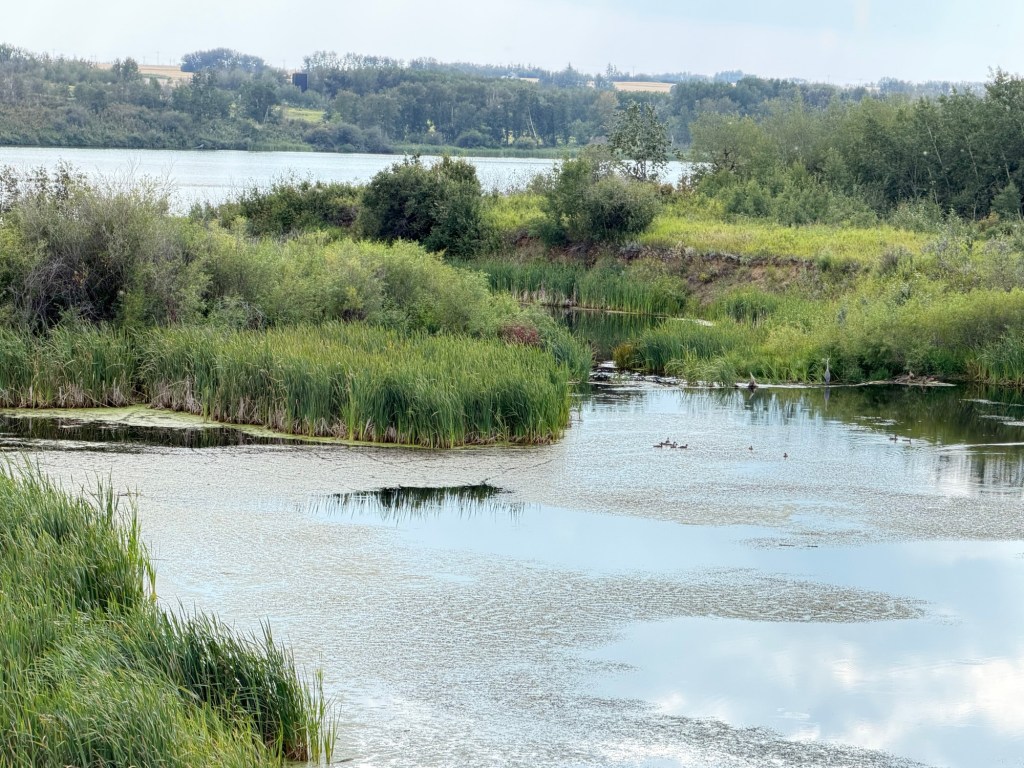
and the Big Gully is full of meandering waterways and ponds,
so it is a great place for birding.
I also saw signs of beaver, though I couldn’t spot a lodge and saw only one small dam.
There are bears here, that’s bear scat, and I saw deer prints, but what I see most often are squirrels and crows.
They have a little beach…
and a playground,
but the big draw here is golf. There is a nine hole course.
The first tee is just a few steps away from our campsite.
Bud and I played a game and I forgot my phone. The next day Bud played and I took pictures. It may be just nine holes but it was plenty challenging for us. It has undulating greens,
some elevation and plenty of water.
The course is well cared for.
It’s a little gem…
in the wide open prairie.
There seem to be a lot of seasonal campers here and every one has a golf cart.
Bud and I went about a half hour away and played disc golf. This, too, was a challenging course. That’s the entrance to the first hole.
There were lots of trees, but also some views.
The course was along the North Saskatchewan River.
We had fun…
and we were the only ones there.
We also drove out to the Pine Island Overlook. That island,actually covered in spruce, was the site of at least five different “forts” or “houses”, as the fur trading posts were called. They were there from 1786 to 1793 and during that time this was the most western active European settlement in Canada. Natives attacked and took one fort in 1793. Others were subsequently abandoned and the Indians then burned them all down.
It sits close to where Big Gully intersects the North Saskatchewan River and both the island and the mouth of Big Gully are now preserved.
The overlook offers a gorgeous view of the area.
The only sound we could hear was the faint noise of a tractor, but we couldn’t see it.
Golf might be what attracts most of the visitors here,
but for us the peace and quiet were equally enjoyed.
Almost as soon as we left Jasper National Park (the park boundary was 35 miles from our campground) we were out of the Rockies.
190 miles later we arrived at St. Albert Kinsmen RV Park and there was not a hill in sight.
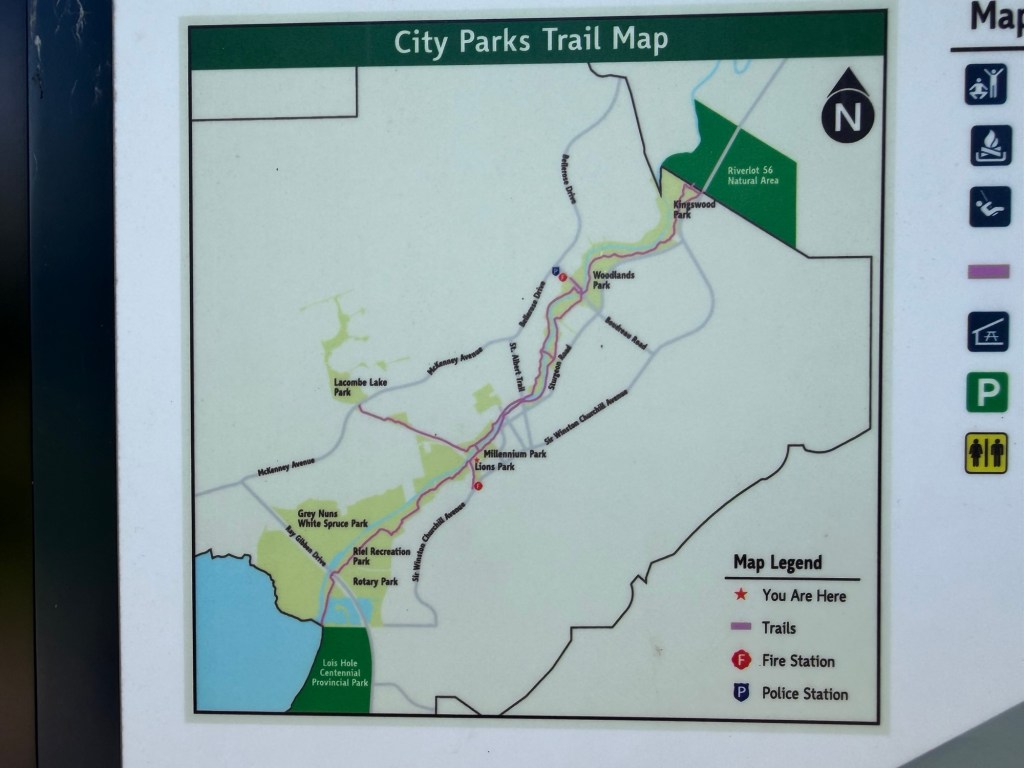
St. Albert is a suburb to the northwest of Edmonton, and all the area is flat.
The Kinsmen are a service club like the Elks or Lions. They also had a banquet hall, a rodeo grounds and a BMX track. Odd combination. The RV park was well maintained, if a bit tight, and had good power. Our only complaint was very low water pressure. We left this morning and intended to rinse our black water tank, but instead just put in the 6 gallons we always use to start the next tank. It took at least 15 minutes to get that 6 gallons in!
But it was right along the Sturgeon River…
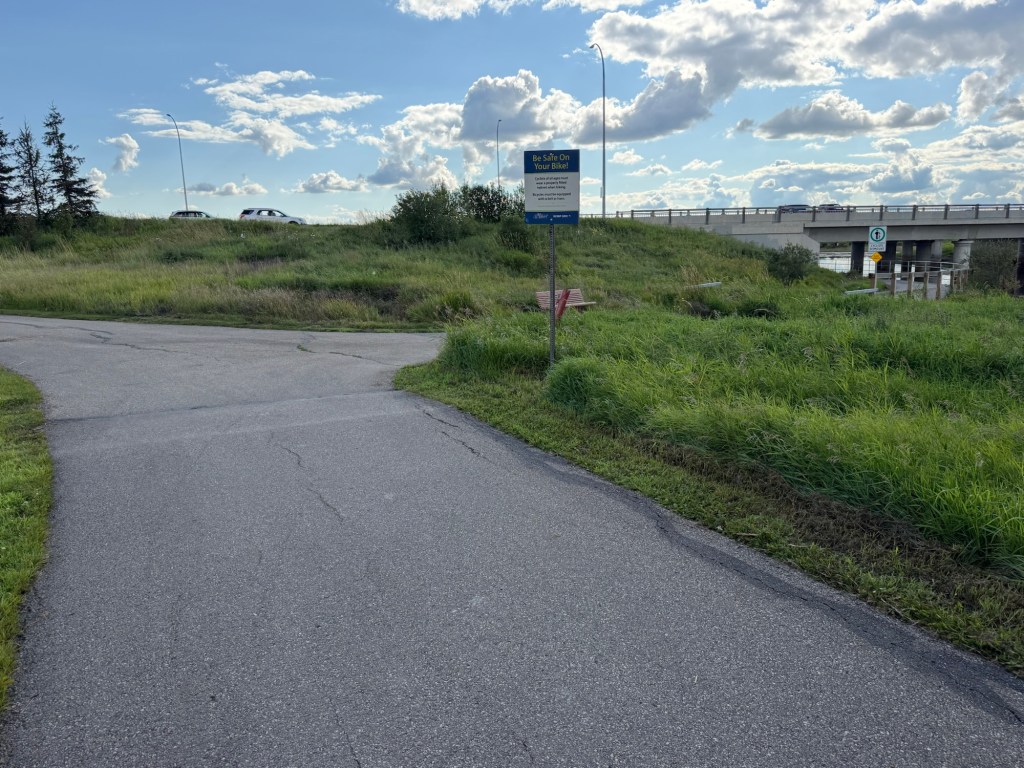
and there was a bike/walking trail along the river. You could cross the bridge or go under it.
Heading southwest on the trail you came to Lois Hole Centennial Provincial Park on Big Lake and this viewing platform. An advantage of the flat land and flat water is that you can really appreciate the sky and clouds.
The park also has a marsh with a boardwalk that zig-zags across it.
If you cross the bridge you can walk in the Grey Nun White Spruce Park.
Unfortunately many of the trails there were flooded.
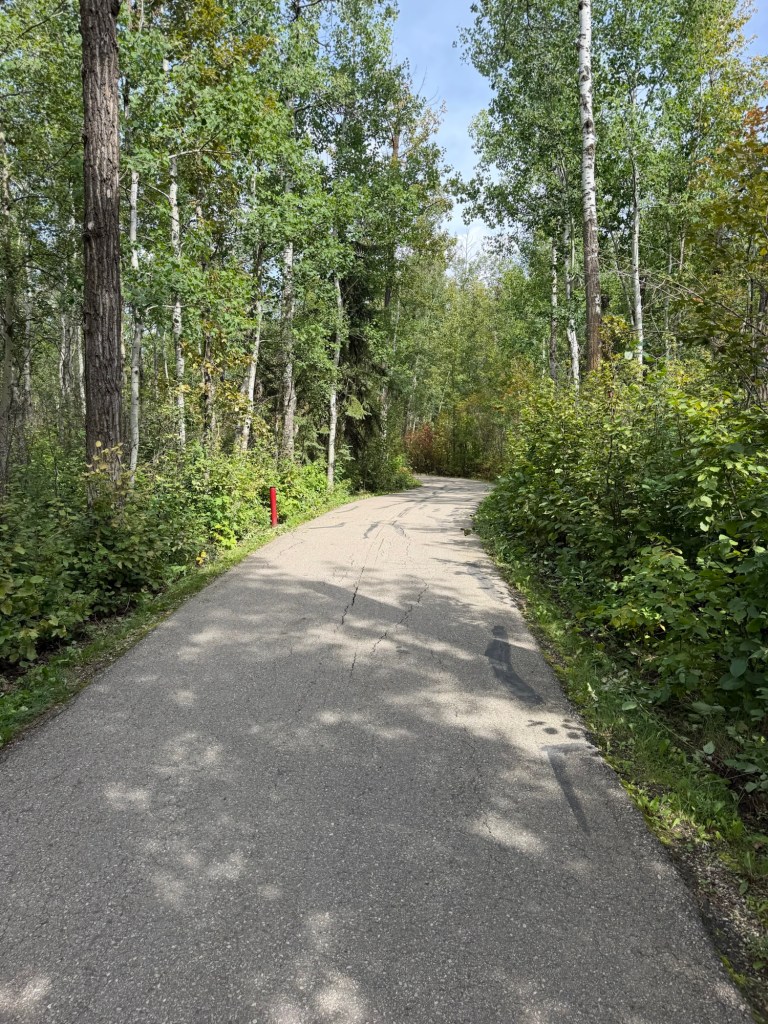
Heading northeast on the river trail you are heading towards downtown St. Albert, though on sections of the trail you wouldn’t know it.
Beaver live here. This small tree was felled by beaver.
That’s their path to the water.
And between an eighth and a quarter mile upstream was their lodge.
This is Lion’s Park along the way, not far from downtown.
You can take a side trail to the commercial area…
or cross a pedestrian bridge…
to ball fields and a grain elevator historic park on the other side.
I didn’t have the chance to go further but the trail led past downtown to the other side of town where there is the Riverfront 56 Natural Area.
There were lots of recreation opportunities. Besides the paths there was this kayak launch dock…
and onshore a cleaning station for your watercraft. And besides the baseball, BMX and rodeo I mentioned there were soccer and rugby fields and we saw folks who had set up on of the rugby fields for cricket.
There were also a number of disc golf courses and we played on two of them.
So although I don’t like the plains as much as the mountains or the seashore, there is certainly beauty here.
Yesterday we had to leave Wapiti Campground in Jasper National Park. Check out was 11 AM and we had a three and a half to four hour trip to our next stop. Bud suggested we get up early, get the camper ready to hitch but leave it in the campground and drive the 62 miles back along the Icefields Parkway to see the glaciers. We don’t know that we’ll be back again so this may be our only chance. We left at 6:15 and drove with the brightening sky with our eyes strained for animals.
When we got to the Athabasca Falls we decided to make a stop there, too. I had been driving, so finally got this picture in the parking lot at 6:34 AM.
There was parking for a couple of hundred people, but only one other couple there as we viewed this roaring falls.
The falls fell in several steps far below us…
carving a narrow and twisted canyon.
When we drove on Bud took the wheel so I could get some photos of the dramatic morning landscape in between helping him watch for animals. (The only animals we saw were a couple of bunches of mule deer right near the campground.)
In places the low clouds touched the ground making visibility difficult.
I had a hard time maintaining my lookout…
as every corner…
brought a new vista…
that I wanted to capture.
We were now approaching the Icefield…
and began to see the edges of the glaciers.
At twenty to seven we were entering the now empty parking lot for the Toe of the Athabasca Glacier Trail.
Along the way we passed date markers that showed the extent of the glacier in that year. In the distance you can see the glacier now, though its toe is hidden by the moraine in front of it.
We were in the shade, but the sun was hitting the ice above us.
This is the valley that the glacier left, with Sunwapta Lake from its melt.
Those pink flowers…
are the very pretty river beauty willow herb. They grow around the globe in the northern latitudes.
From the lot it is a bit over a half mile hike to the Toe of the Athabasca Glacier Viewpoint. When we got high enough up the trail we could look back and see the huge Columbia Icefield Centre. In 1844 the glacier reached all the way across to there.
Here’s another date marker, but you still can’t see the actual toe of the glacier.
The most recent rubble left by the glacier still obscures it from the 2006 date marker.
Now you can see the edge of the glacier reflected in the pool of melt water.
I did some research and in 2012 the glacier came close to where I stood to take this picture and went about two thirds of the way up the dark grey gravel wall on its right edge.
Two young Canadian women were also there and kindly took our picture.
They also told us this machine was probably a remote device to test and map crevices. You can take a guided walk on the glacier, but even the guides need updated information as crevices can open overnight. The one woman had walked on the glacier as a kid, before they required you to go with a guide. Her dad often repeated the warning tale of a boy who fell into a 40 foot deep crevice and froze to death.
Looking from a distance it’s hard to realized the size, weight and power of the glacier, but the striations on these rocks were made when this glacier originally oozed down the valley.
On the way out I looked back, but the sun still hadn’t reached the surface of the glacier.
It was a good walk downhill to get back to the truck.
Driving back to the camper there was more light on the mountains…
and plenty of people headed up to fill the parking lots.
We had a beautiful…
hour long drive back.
By 10:45 we were hitched up, had emptied our holding tanks and were ready to head out. Goodbye Jasper. I’m glad we added that early morning trek to our day.
Even with fire in 2024 the views everywhere here are like picture postcards. I just took this picture from inside the camper sitting in my recliner. I may live in a trailer but you just can’t beat my yard.
Yesterday we drove a couple of miles to hike up Old Fort Hill.
The trail starts up these steps.
At the top you get a nice view of the Athabasca River.
And then you start up.
And the views get better.
Bud kept thinking he was going to stop.
But then hiked on up to the next level.
And in the end he hiked the half mile to the top for some very nice views…
of mountains and the river…
and the town.
It was a lot easier walking back down.
When we were almost down some rafters came by.
Bud drove back, but I decided to hike back. Notice that the trees right here hadn’t burned;
but this resort was not so lucky.
The trail followed the river.
It crossed the little Miette River…
at the point where it flowed into the Athabasca River. I looked up why the river from glacier melt was so white and cloudy. It’s because the glacier has ground the rocks beneath it to a powder. When it melts that very fine powder is suspended in the water and flows for miles and miles with the river.
The trail system around here is very well marked.
There are still trails closed from the fire, I think mostly where there are banks destabilized because the trees burned off them.
Today we drove up along the Maligne (muh LENE) River to Maligne Lake. We stopped here and I got to take a couple of pictures, I was driving so no pictures along the way.
There are signs everywhere saying not to feed the wildlife, but obviously not everyone heeds them.
I must admit, this little guy was hard to turn down.
When we got to Maligne Lake we took the Moose Lake Loop. According to the Jasper National Park Visitor Guide this is a “forested trail to a peaceful lake, where moose are often seen.”
This is Moose Lake.
This is the moose.
We weren’t the only ones watching her.
She didn’t seem at all fazed by her admirers.
We walked across the end of the lake from one moose viewing area to another. The moose was now quite close to where we had been.
Obviously not everyone had read the sign.
Admittedly she almost acted like she was on the park payroll. I half expected her to clock out and have a second shift moose come to pose for the crowds.
After about 15 minutes and 50 photos we moved along to the shore of Maligne Lake and the end of our walk.
The water from Lake Maligne flows down the Maligne River…
to Medicine Lake.
The outflow of Medicine Lake is dry unless there is an unusually large snowmelt. Otherwise, all the water drains through gravel strewn openings in the bottom of the lake. In summer these are covered with water, but by winter the lake consists of just a few frozen ponds over these openings.
The water reappears miles below in Maligne Canyon; unfortunately that is an area still closed from the fire.
I was able to take this video that seems to show the water running into and out of the rocks.
I was far above on the overlook, so I’m not exactly sure of the way the water flowed.
I needed to do more walking so in the afternoon I had Bud drop me off in town.
I visited the park store…
and got a magnet for our collection. We have US National Parks on the freezer door of our refrigerator and Canadian parks below.
I walked back…
through this pretty town.
They are still rebuilding the west end of town.
The pedestrian walkway…
under the railroad tracks was either unharmed or repaired,
and the trail markers were still there, even if the tree was all but gone. Notice the nearby tree, unscathed for some reason.
Everything is well marked and easy to follow.
I was soon back to the part of the path I had taken the day before, but today I chose to take a side trail…
that led closer to the river.
I was impressed by the power of the current. This is a lot of water just fifty miles from its source.
I then came to a section of the trail that was a causeway. I love the money that is invested to facilitate foot and bike traffic here.
A great ending to a great couple of days was coming back to camp to find mule deer hanging out in the campground. I took these photos without any zoom.
One of the deer stayed right at the edge of the road and watched me as I walked by.
This is another corner of this gorgeous earth we have been privileged to visit.
Yesterday morning we left our campsite for a 180 mile drive to Jasper. For the entire drive we were in National Parks. After about 45 miles we left Trans Canada Highway One for Route 93, the Icefield Parkway. This is a two lane road through some of the most spectacular scenery around.
This is Bow Lake.
Almost all my photos are from the moving truck because our truck and trailer had no chance of parking at any of the viewpoints.
Still, the views we saw were fantastic.
We could see what seemed to be ice in the distance.
Even at the non- view pull outs…
the scenery was beautiful.
These were spectacular mountains.
We crossed…
and then followed the North Saskatchewan River upstream.
Here it’s a wide shallow river carrying melt from the Columbia Icefield, from which the parkway gets its name.
We continued through spectacular peaks…
catching glimpses of ice…
until we climbed a pass and left the North Saskatchewan River behind.
We saw more peaks…
and more ice.
There was no way we could park
at the Icefield Centre,
so we had to be content with a passing view.
It was all quite beautiful.
We came down from the pass to drive along the Athabasca River, the first river I’ve seen that flows into the Arctic Ocean.
Now we are at Wapiti Campground in Jasper. It burned two years ago so is stark, but still beautiful.
And the campground lies along the Athabasca River. Nice.
Bud and I decided to take the short hike up to Silverton Falls. We took the Bow Valley Parkway to get to the trailhead. This has a pretty low speed limit, and that’s good because we were able to slow down and not hit this black bear as it crossed the road in front of us. This is the third bear that’s crossed in front of us on this trip to Canada, but the first time I’ve gotten a decent photo.
Soon after we started our hike we could hear what I thought was the falls.
It was not, it was just pretty Silverton Creek hurrying downhill.
To get to the falls we had to walk quite a bit higher and come across this section of questionable trail.
I could see the terrain was steep and was happy to stay on the trail.
The creek was now far below us…
but as we came around a shoulder of the hill we saw the small, but fairly spectacular falls descending from far above us.
Turning my phone I could get what we could see of the falls diagonally in the field of view.
I think the view of the far valley would have been stunning, but there was still smoke.
Later that day I set off down snake hill into town to check out a laundromat.
Right in town I came across this female mule deer grazing at the side of the street.
I was following a walking route on Apple Maps. I wondered what this was about.
Oh the tracks.
I crossed…
despite the warning…
as this was obviously a well established path.
Unfortunately this was a commercial laundry, strike number two; the laundry closest to our campground was out of business.
But the walk was not a total loss; on the way back I saw the fawn and just past it I saw mama deer again.
I had the return route on my phone but wasn’t watching it. It buzzed and I looked and it said I had arrived.
Yes I had. Scarily accurate!
The next day Bud and I took the bus back into town, The ride to town is free. We stopped at the Visitor Center and each got an all day pass for the busses in and around town for $2.50 Canadian.
We walked the few blocks down to the pretty little park museum. It was almost entirely the old fashioned natural history displays of stuffed birds and animals. A lovely setting but a bit depressing to me.
We then took the bus up to the Cave and the Basin. Walking into the cave…
you come to this hot spring of mineral water.
This is the first part of Banff to be protected as a National Reserve and two years later, in 1887 became the core of the first Canadian National Park, Rocky Mountains National Park, which in 1930 was renamed Banff National Park.
Outside, there is a larger, cooler and less sulfurous spring fed pool called the basin.
There are nine springs on Sulphur Mountain.
These thermal springs are the only place where the Banff snail lives. The snails are quite pretty up close and cleaned off but in the pools they are these little blobs of slime.
We took the bus back to the center of town and went to the beer store. Bud took his beer and headed to the bus stop to catch the bus back to the campground.
I opted to walk, first through town,
then on a lovely walking path…
along the Bow River.
I was just able to see the falls from above.
I then got on the trail to the Hoodoo Viewpoint that took me back to camp.
I’ve done two more big walks. Sunday I walked into town on the Surprise Corner to HooDoos Trail. It was a lot easier going down this trail.
I walked by this raven, he was huge, almost twice the size of a crow.
This time I took the time to walk down the lookout trail at Surprise Corner.
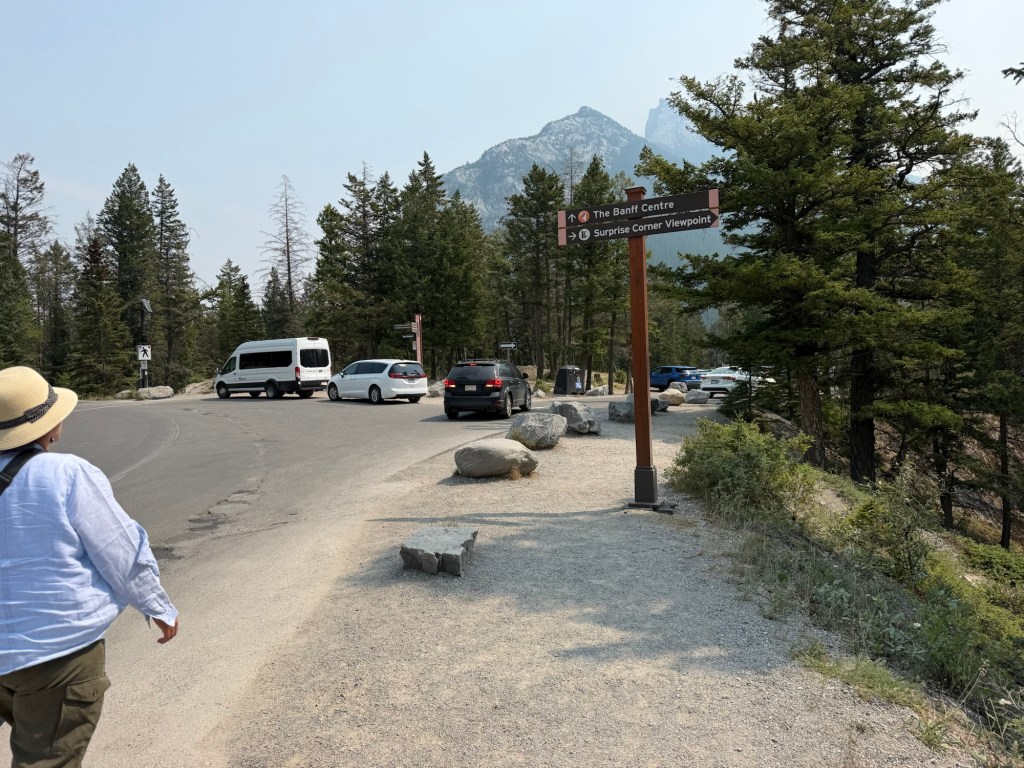
The parking lot is always full here,
so much so that there is a warning sign on the street because cars might be stopped in the road waiting to turn into the lot. So I thought I should take the time to see what was there.
The main trail took me down to a place where a side channel joined the main channel of the Bow River just below the falls.
Raft rides started there.
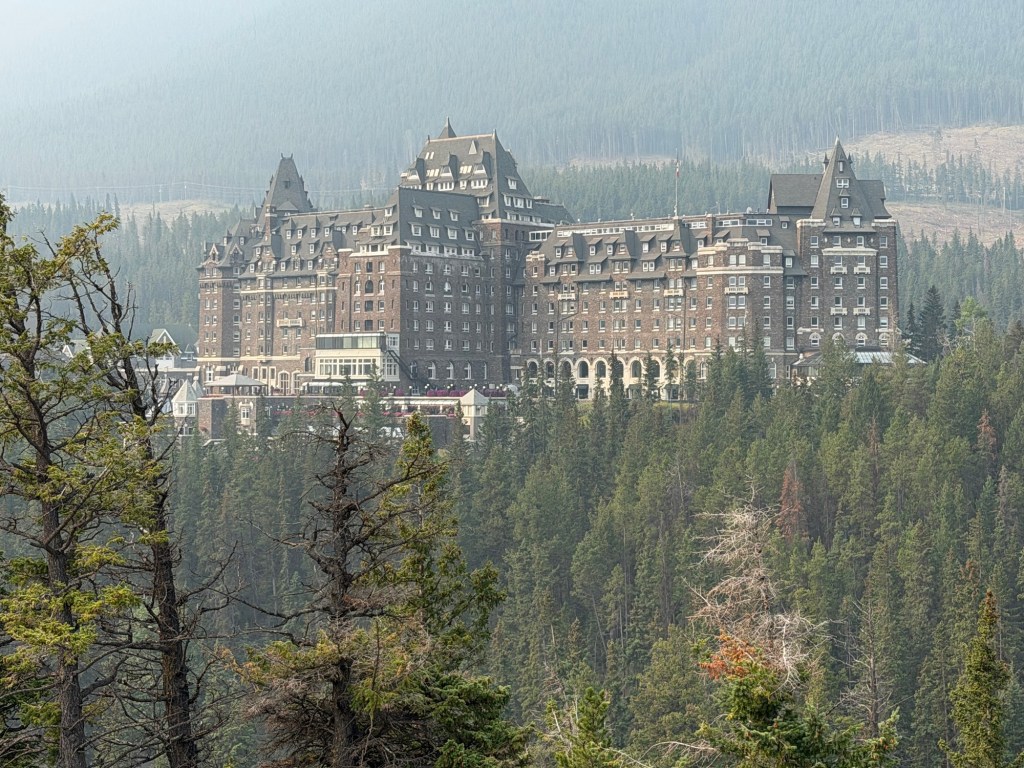
You could see the huge Fairmont Banff Springs across the river and you could hear the falls,
but no matter where I climbed on the little paths, I couldn’t see the falls.
I gave up and continued to the parking lot. Across the street I saw these stairs to a viewing platform. Oh, I thought, that’s where you see the falls.
But no, just a better view of the Fairmont,
and you couldn’t see the falls at all, not even a glimpse of river. Surprise Corner? Yes, I thought, you can hear the water roaring, but surprise, you can’t see it!
Anyway I continued on the nice trail along the river,
past the bridge…
and up into town. I did a bit of shopping, saw the striking town hall,
passed this well disguised parking garage and came back up snake hill. Altogether it was a nice six mile hike.
Today I drove to a nearby town to do laundry. I also taped rodent barriers under the front of the trailer. We’ve tried small containers of moth balls and an electronic rodent repeller, but watched a squirrel go right past those, up inside the cap of the trailer and then heard his little feet walking in the space above our heads over our bed. I banged on the wood there and he came out, but we decided a real barrier was needed. This is foil window insulation cut to fit and duct taped over the openings under the front of the trailer. We’ll see if that works.
I still wanted to get a walk in so took the path around the Tunnel Mountain campgrounds. It was 4.2 miles long and I was never more than a couple hundred feet from a campsite. I saw this spruce grouse along the way.
Looking up you could see the sunshine,
and you could sort of see the nearby mountains,
but the fires in British Columbia are worse than ever and so was the smoke. I’m grateful we came through when we did, because the road we took to Kelowna has been closed for the last three days. Tomorrow we travel north to Jasper and we may leave the smoke behind.
We’re in the Rockies now. As soon as we crossed the Continental Divide and the border into Alberta we were in Banff National Park. As we came the additional 43 miles to get down to the town of Banff and our campground we passed numerous wildlife bridges and underpasses on Highway One. This is one of them.
This is a National Park campground, but with a name like Tunnel Mountain Trailer Court I wasn’t expecting much. Turns out it’s pretty nice.
We have full hookups and a reasonable amount of space around us.
There are two more campgrounds here. Tunnel Mountain Village I has more space but no services.
Tunnel Mountain Village II has only electricity, but no privacy at all, so I’m glad we were able to get a site where we are. I should say sites, because even though I went online the minute reservations opened, I couldn’t get six nights in one site. We’ve had two nights in site 403, today we have to move for one night to site 611, then tomorrow we come back for three more nights in site 403. Kind of a pain, but that’s how popular Banff is.
And with views like this…
you can understand why.
The day we got here I walked the two miles into town to the Visitors Center. This is the first half mile of the trail.
Then you emerge into the very busy town.
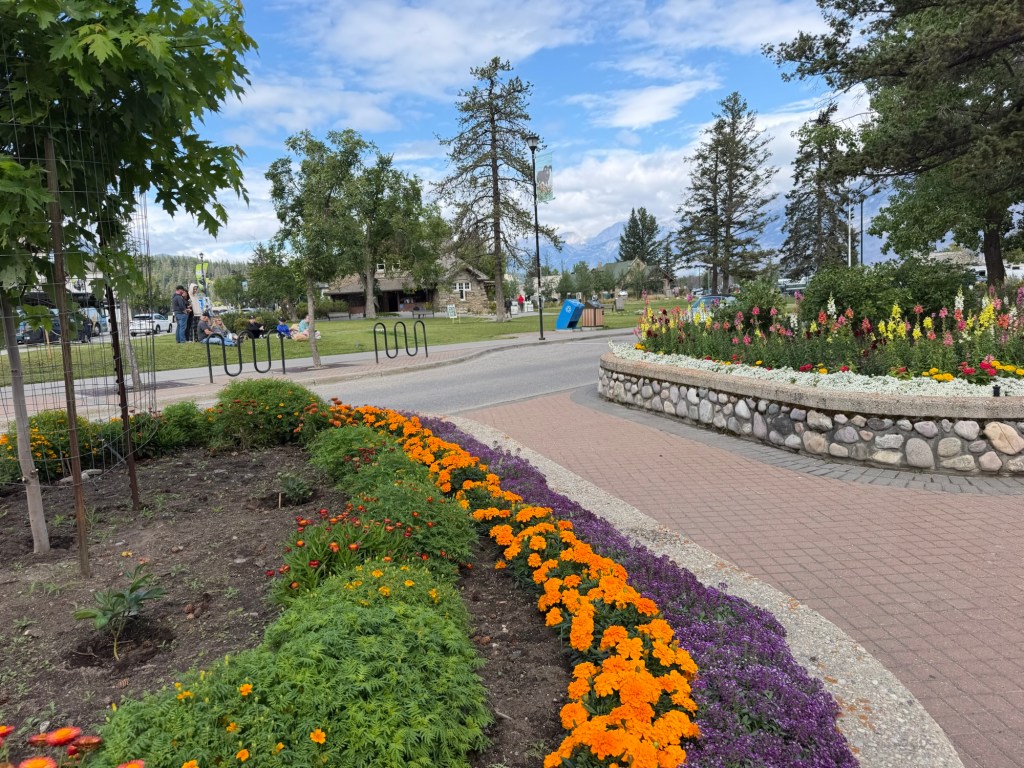
All around the backdrop is the mountains.
It’s really quite pretty,
most everyone has a mountain view.
Yesterday Bud and I took a walk through the campground to a nearby viewpoint.
On the way we saw several of these guys, they almost looked like prairie dogs. They are Columbian ground squirrels, and are larger than any other ground squirrels we’ve seen. Their burrows were right between the sites in the campground.
The lookout we walked to was to view these hoodoos; certainly not anywhere near as impressive as those in Bryce Canyon,
but quite incongruous in this beautiful valley of the Bow River.
They had the famous red Adirondack chairs and Bud took my photo as I tried them out.
After lunch Bud dropped me off at the Surprise Corner trailhead. He couldn’t even take a look as there was nowhere to park. The black car is waiting for someone to come out, so it can go in.
There were a lot of people around,
but as soon as I turned onto the longer trail I was alone.
This trail led along the base of Tunnel Mountain…
and along the Bow River.
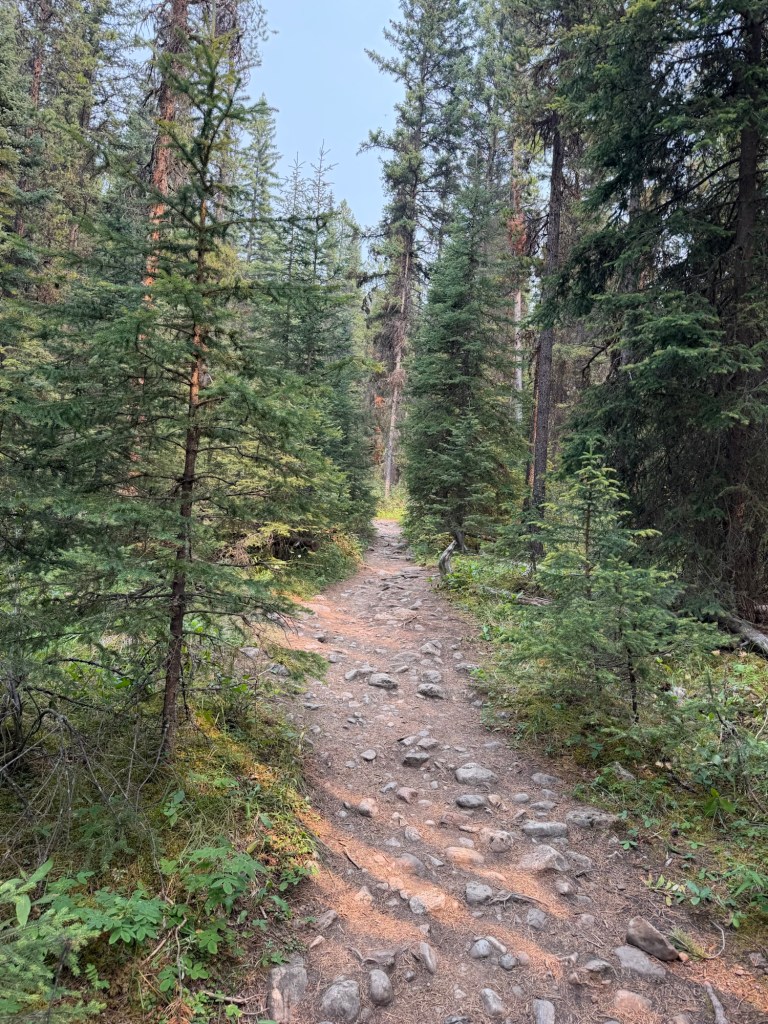
A lot of it was a pleasant walk through the wooded valley…
and it was well marked.
Eventually I got far enough away to get a good look at Tunnel Mountain.
I haven’t been able to find the name of this mountain, but I like it. It looks like a wave done in stone.
My trail went up over a spur of Tunnel Mountain that reached the river.
Now I was along all of Bow River. I realized on seeing this that the first view was a channel around an island. This water, like all the rivers and creeks up here, was very cold;
those kayakers better stay upright unless they want a real chill.
I got a pretty good workout as the trail led from the river…
back up to the level of the lookout we visited in the morning. Unfortunately smoke was moving in. There are no fires close, so the amount of smoke depends on the wind.
Now we’ve just finished our move to site 611. This afternoon we’re taking a drive to see more of this beautiful country.